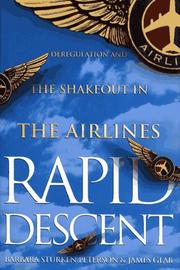
Rapid Descent
Summary
Barbara Sturken Peterson and James Glab, both aviation journalists, chronicle the American airline industry in the decade and a half after deregulation in 1978. The book is a history of the resulting competitive upheaval and of the people who drove it.
The narrative covers the deregulation legislation and Alfred Kahn's role, the entry of low-cost carriers including People Express, the failures of established carriers including Braniff, Eastern and Pan American, and the consolidation that followed. Frank Lorenzo is the central figure: his acquisition of Continental, the 1983 bankruptcy filing used to abrogate labour contracts, the acquisitions of People Express, New York Air and Eastern, and the destruction of Eastern through the 1989 strike. The authors also cover the development of hub-and-spoke networks, computer reservation systems and their competitive use, frequent flyer programmes, and yield management.
The argument implicit in the reporting is that deregulation delivered lower fares and more travel while destroying most of the incumbent carriers and their employees' terms, and that the industry's structure converged toward concentrated hub dominance rather than the competitive market its advocates predicted. The book was published in 1994, before the second wave of consolidation, before Southwest's expansion to national scale, before the post-2001 bankruptcies and before the current four-carrier structure. It is journalism rather than industry economics, and readers wanting the latter should go to the academic literature on airline competition.
Key takeaways 7
- Deregulation lowered fares and expanded travel while destroying most of the carriers that existed when it began.
- Hub-and-spoke networks concentrated market power at individual airports, which produced local monopoly pricing within a nationally competitive industry.
- Bankruptcy filing became a competitive instrument for abrogating labour contracts rather than a response to insolvency.
- Computer reservation systems owned by carriers were used to bias travel agent bookings until regulators intervened.
- Frequent flyer programmes raised switching costs enough to protect incumbents against low-fare entrants on the same routes.
- Labour cost differences rather than operational efficiency drove most of the competitive advantage low-cost entrants held.
- The authors argue that the industry's capital intensity and cyclicality make sustained profitability structurally unlikely regardless of regulation.
Who should read it
Investors in airlines and analysts of deregulated industries who want a narrative history of what the first fifteen years of open competition produced.
Where it sits in the reference 2
Similar books 6
Chosen by shared topics, the entries that hold them, and the people who recommended both.