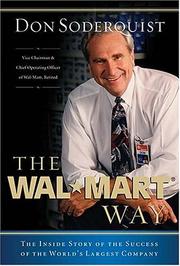
The Wal-Mart Way
Insider account by the long-serving chief operating officer.
Summary
Soderquist joined Wal-Mart in 1980 from Ben Franklin Stores and served as chief operating officer and vice chairman until 2000. He wrote an insider account of the company's culture and management practices during its expansion from a regional chain to the largest retailer in the world.
The content is largely about operating discipline and values as he experienced them. He describes the Saturday morning meeting where merchandising decisions were made on the previous week's numbers, the practice of sending executives into stores every week, the open-door policy for associates, the store-within-a-store approach that gave department managers profit and loss responsibility for their sections, and the aggressive expense control that ran from shared hotel rooms to the design of the home office. He also gives Sam Walton's approach to competitors, which was to visit their stores constantly and copy what worked.
The framing is explicitly values-based. Soderquist argues that Wal-Mart's growth came from treating associates as partners, serving customers, and maintaining what he calls servant leadership, and he connects this to his own Christian faith.
This is a company insider's account published by an executive who benefited from the company's success, and it reads as such. It does not engage with the substantial criticism of Wal-Mart on wages, healthcare, the effect on supplier margins, the effect on small-town retailers, or the sex discrimination litigation. Charles Fishman's The Wal-Mart Effect covers that ground. The operational detail is genuine and useful; the interpretive frame should be treated as advocacy.
Key takeaways 7
- Wal-Mart's weekly Saturday meeting allowed merchandising decisions to be made on the previous week's actual sales data.
- Giving department managers profit and loss responsibility for their section produced ownership behaviour at store level.
- Executives spending most of the week in stores kept decision-making connected to what customers were actually doing.
- Extreme expense discipline at the corporate centre was communicated as a signal to the whole organisation rather than as a cost saving.
- Sam Walton built the company partly by systematically visiting competitors and copying their better practices.
- Calling employees associates and inviting their suggestions produced operating improvements that headquarters would not have found.
- Culture is transmitted by what senior executives visibly do rather than by what the company publishes.
Who should read it
Retail and multi-site operators who want an insider account of Wal-Mart's operating cadence, read alongside independent accounts of its effects.
Where it sits in the reference 2
Who recommended it 1 · 1 direct
Similar books 6
Chosen by shared topics, the entries that hold them, and the people who recommended both.