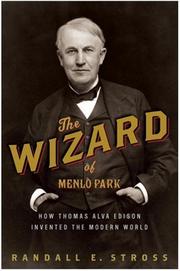
The Wizard of Menlo Park
Edison as the first manufactured celebrity.
Summary
Stross argues that Edison's most consequential invention was his own celebrity. He documents how Edison, from the phonograph announcement in 1877 onward, cultivated newspaper reporters, announced inventions before they worked, and built a public identity as the wizard which he then converted into capital, credit and commercial advantage.
The reporting establishes a pattern. Edison would announce a breakthrough to the press, the announcement would move markets and attract investors, and he would then attempt to build the thing. The electric light announcement preceded a working lamp by more than a year and was made partly to depress gas company shares. Many of the announced inventions never worked. Stross covers the failures at length, including the iron ore separation venture that consumed years and most of Edison's fortune, the concrete house, the electric car battery, and the film business he lost control of.
Stross also examines the Menlo Park laboratory as an organisational innovation, an industrial research operation with a staff of specialists working on commercial problems, and argues this was a more durable contribution than most of the individual inventions. He is direct that Edison's technical judgement was often poor, particularly on direct current, and that his managerial performance was worse.
The book is a corrective to hagiography and is written from newspaper archives and the Edison papers. Readers wanting technical history of the inventions themselves should look elsewhere, since Stross's subject is the manufacture and management of reputation. Some reviewers have found the debunking framing insistent.
Key takeaways 7
- Edison's most valuable creation was his public identity, which he converted into investment capital, credit and commercial advantage repeatedly.
- He announced inventions to the press before they worked, and the announcements themselves moved markets and attracted the financing needed to build the thing.
- The Menlo Park laboratory was an organisational innovation, being the first industrial research operation staffed with specialists working on commercial problems.
- Most of Edison's ventures failed, and the iron ore separation project consumed years and most of his accumulated fortune.
- His technical judgement was frequently wrong, most consequentially on direct current, and his commitment to it cost him control of his own company.
- Edison's managerial performance was poor, and the businesses built on his inventions succeeded when others ran them.
- Sustained press attention functions as a financial asset for an inventor or founder, and Edison was the first person to manage it deliberately.
Who should read it
Founders and investors interested in how reputation is manufactured and converted into capital, and in the origin of the industrial research laboratory.
About Randall E. Stross
Business historian and journalist, longtime professor at San Jose State University; wrote reported histories of Edison, Microsoft, Google and Y Combinator.
Each book reports one organisation from inside over a defined stretch of time: a year among Y Combinator's batch companies, Benchmark's partners through the dot-com IPO wave, Edison's Menlo Park laboratory. The result records how venture firms and inventors actually spent their days, which reads as evidence rather than retrospective summary.
Where it sits in the reference 2
Who recommended it 2 · 1 direct
Similar books 6
Chosen by shared topics, the entries that hold them, and the people who recommended both.