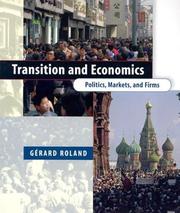
Transition and Economics
The theory of sequencing: why gradualism beat shock therapy in some places.
Summary
Gerard Roland wrote the most analytically rigorous treatment of the postcommunist transition, applying formal political economy to the questions that the policy debate had argued over informally.
His central contribution is to reframe the gradualism versus shock therapy dispute in terms that can be analysed. He identifies aggregate uncertainty, meaning nobody knows whether a reform will work, and individual uncertainty, meaning nobody knows how a reform will affect them personally, and shows that these produce different political dynamics. Reforms with high individual uncertainty may be blocked before implementation even when a majority would benefit, because people fear being among the losers. Once implemented, a reform that benefits a majority becomes irreversible, which is the case for partial reform as a strategy: it creates constituencies for further reform. Against this he sets complementarities between reforms, which is the case for comprehensiveness, since partial reform can produce worse outcomes than either the starting point or the complete programme.
He applies this to the actual sequences: price liberalisation, privatisation, restructuring, and the building of legal and financial institutions. He also examines the Chinese gradual path and argues that its success reflected specific initial conditions rather than a generally superior method. The book is formal, uses game-theoretic reasoning throughout, and is written for economists. It is the place to go for the transition debate stated rigorously rather than polemically.
Key takeaways 7
- Individual uncertainty about who will lose can block a reform that a majority would benefit from once implemented.
- Partial reform creates constituencies that support further reform, which is the analytical case for gradualism.
- Complementarities between reforms mean that partial implementation can produce worse outcomes than either no reform or complete reform.
- Reversal costs make a reform irreversible once a majority benefits, which is why the order of implementation matters.
- Roland argues that China's gradual path succeeded because of specific initial conditions rather than because gradualism is generally superior.
- Privatisation without restructuring transfers ownership without changing behaviour, so sequencing between them determines the outcome.
- The gradualism debate can be analysed formally rather than argued over, and the answer depends on the specific reform's properties.
Who should read it
Economists and serious policy readers who want the transition debate analysed formally rather than as a contest between advocates.
Where it sits in the reference 2
Similar books 6
Chosen by shared topics, the entries that hold them, and the people who recommended both.