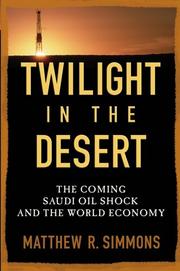
Twilight in the Desert
The peak-oil case against Saudi reserve claims; wrong but influential.
Summary
Simmons, an energy investment banker, argued that Saudi Arabian oil production was closer to its limit than the kingdom disclosed, and that a decline in Saudi output would be a global economic event. He built the argument from about two hundred technical papers published by Saudi Aramco engineers in Society of Petroleum Engineers journals.
His method was to read the technical literature for evidence about field conditions, since Saudi reserve figures are not audited and production data is not disclosed in detail. He found accounts of water injection at Ghawar, rising water cut in producing wells, the use of horizontal drilling and maximum reservoir contact wells to maintain flow rates, and engineering discussions consistent with mature fields being managed aggressively to hold production. From this he argued that Saudi Arabia's ability to increase output substantially was doubtful and that its ability to maintain existing output was uncertain.
The broader claim was that global oil production would peak in the near term and that markets, governments and investors were assuming a supply capacity that did not exist.
The forecast has not been borne out. Saudi production has been sustained and world oil production rose substantially after 2008, principally from American shale, which Simmons did not anticipate. His method, reading technical literature for evidence in the absence of disclosure, remains sound and his questions about reserve reporting were legitimate. Read it as a case in how a well-researched argument can be correct about the evidence available and wrong about the outcome because of a technology change outside its frame.
Key takeaways 7
- Saudi reserve figures are not independently audited and detailed production data is not disclosed, which means outside assessment must be inferred from technical publications.
- Aramco engineering papers described water injection, rising water cut and advanced completion techniques consistent with mature fields being managed to hold production.
- Maintaining flow rates in a mature field through advanced techniques can conceal depletion until the decline arrives abruptly rather than gradually.
- Global oil supply forecasts rest on Saudi capacity figures that no external party can verify, which is a structural information problem rather than a temporary one.
- Reading technical literature is a viable method for assessing an opaque producer, since engineers publish operational detail that corporate disclosure omits.
- The peak oil forecast failed because horizontal drilling and hydraulic fracturing added supply from sources the analysis did not contemplate.
- A supply forecast is only as good as its assumptions about which technologies will become economic, and those are the assumptions least examined.
Who should read it
Energy investors interested in analysing opaque producers from technical literature, and in a case study of a rigorous forecast defeated by a technology change.
Where it sits in the reference 3
Who recommended it 1 · 1 direct
Similar books 6
Chosen by shared topics, the entries that hold them, and the people who recommended both.