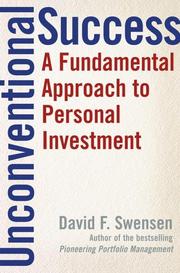
Unconventional Success
Subtitled A Fundamental Approach to Personal Investment.
Summary
Swensen wrote this after Pioneering Portfolio Management, and it reverses the audience: the earlier book was for institutions with the resources to run an endowment model, this one tells individuals that they cannot replicate it and should not try. His prescription is a diversified portfolio of six asset classes held through low-cost index funds, with domestic equities, foreign developed equities, emerging market equities, real estate investment trusts, Treasury bonds and Treasury Inflation-Protected Securities, rebalanced on a disciplined schedule.
The longer and angrier half of the book is an attack on the mutual fund industry. Swensen documents how fee loads, soft-dollar arrangements, 12b-1 fees, stale-price arbitrage, revenue sharing with brokers, and the incentive of fund companies to maximise assets rather than returns all transfer money from investors to managers. He is specific about firms and practices, and his central claim is structural: a for-profit fund company owes a fiduciary duty to its own shareholders that conflicts directly with its duty to fund holders, which is why Vanguard's mutual ownership structure produces different behaviour.
The asset allocation advice is deliberately conservative about credit. Swensen argues that corporate bonds, high yield, asset-backed securities and non-Treasury fixed income all give the investor exposure to call options and default risk without adequate compensation, and that fixed income should serve only as deflation and crisis protection. That position remains contested among practitioners. The specific allocation weights and the enthusiasm for REITs as a distinct asset class have also been criticised, and the tax-efficiency chapters reflect United States rules from the mid-2000s.
Key takeaways 7
- Individual investors should hold only equity-like assets that generate returns and Treasury securities that provide crisis protection, and should avoid corporate credit entirely.
- Mutual fund companies owned by outside shareholders face an unresolvable conflict between maximising fee revenue and serving investors, which is why the industry's average product loses to the index.
- Asset allocation, not security selection or market timing, accounts for the overwhelming majority of portfolio return variation.
- Rebalancing to fixed weights is the discipline that produces most of the added value available to an individual investor.
- Actively managed funds fail after fees, taxes and survivorship bias are all counted, and the published performance data systematically overstates how they did.
- Non-profit fund structures, of which Vanguard is the main example, are the only ones whose economics align with the investor.
- Market timing and performance chasing destroy more individual investor return than fees do.
Who should read it
Individual investors and family office allocators who want a rigorous argument for a simple, low-cost, Treasury-anchored portfolio and a documented case against the retail fund industry.
About David F. Swensen
Chief Investment Officer, Yale University 1985-2021
Pioneering Portfolio Management defined the endowment model that institutional investors worldwide copied, and Unconventional Success is its counterpart argument for individuals.
Where it sits in the reference 3
Who recommended it 2 · 2 direct
Similar books 6
Chosen by shared topics, the entries that hold them, and the people who recommended both.