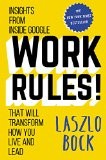
Work Rules!
Insider account of Google's people operations by its SVP of HR.
Summary
Bock ran people operations at Google from 2006 to 2016 and documents the company's approach to hiring, management, compensation and culture, with the internal data behind the decisions. It is more empirical than most human resources books because Google ran experiments on its own workforce and Bock reports the results including the failures.
The hiring material is the strongest. Bock reports that Google found unstructured interviews had almost no predictive validity, that brainteasers predicted nothing, and that the company reduced interviews from as many as twenty-five to four after finding that the fourth interview added almost nothing to the prediction. He describes structured behavioural interviews with defined rubrics, hiring committees that remove the decision from the hiring manager, and the finding that the best predictor was a combination of work sample tests, structured interviews and general cognitive ability.
The management material covers Project Oxygen, which analysed performance data to identify what distinguished effective managers and found that technical expertise ranked last among eight behaviours, and the practice of separating performance reviews from development conversations. Other material covers pay unfairly, meaning that contribution distributions are highly skewed so pay should be too; giving employees more decision authority than is comfortable; the two tails approach of studying the best and worst performers rather than the average; and the argument that removing managers' unilateral authority over hiring, promotion and pay reduces bias.
The book generalises from a company with extraordinary selection advantages and enormous margins, and much of the practice is expensive. Bock is an advocate for his own record. The hiring findings and the interview research are the parts that transfer.
Key takeaways 8
- Unstructured interviews have almost no ability to predict job performance, and the confidence interviewers feel in their judgments is unrelated to accuracy.
- Four interviews capture nearly all the predictive value available, and additional interviews add cost without improving the decision.
- The best predictors of performance combine work sample tests, structured behavioural interviews with defined rubrics, and general cognitive ability.
- Removing hiring decisions from the individual manager and giving them to a committee reduces bias and improves consistency.
- Technical expertise ranked last among the behaviours that distinguished effective managers in Google's own performance data.
- Contribution to output is highly skewed, so compensation distributions should be skewed rather than compressed toward the average.
- Performance evaluation and development conversations should be separated, because people cannot receive developmental feedback while their pay is being decided.
- Studying the best and worst performers rather than the average produces more useful information about what actually drives outcomes.
Who should read it
Executives and people leaders redesigning hiring and management processes who want data from a company that ran the experiments.
Where it sits in the reference 4
Who recommended it 5 · 1 direct
Similar books 6
Chosen by shared topics, the entries that hold them, and the people who recommended both.