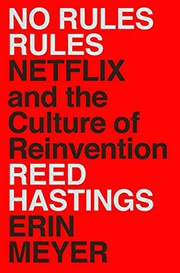
No Rules Rules
Insider account by the co-founder and CEO of the Netflix culture.
Summary
Hastings, Netflix's co-founder, writes alternating chapters with Erin Meyer, a business school professor who interviewed employees and adds outside perspective and cross-cultural analysis. The structure is a sequence in which each step becomes possible only after the previous ones are in place.
The sequence begins with talent density, achieved by paying top of market and by removing adequate performers, which Hastings argues is the precondition for everything else. It proceeds to candour, implemented through explicit feedback norms including live feedback in meetings and written 360 reviews. Only after both are established does he introduce the removal of controls: no vacation policy, no expense approval, no spending limits, replaced by the instruction to act in Netflix's best interest.
The most discussed practice is the keeper test, in which managers ask whether they would fight to retain each person and remove those they would not, with a substantial severance payment. Hastings defends this directly and Meyer reports the effect on employees, including the fear it produces, which Hastings acknowledges as a cost.
Other practices include context rather than control, meaning that leaders provide the information for decisions rather than making them; the dispersed decision-making model in which no approval is required and the person closest to the information decides; sunshining, meaning that failed decisions are shared publicly by the person who made them; and paying personal top of market rather than using salary bands. The model works at a company with extraordinary margins and the ability to select from an enormous applicant pool. Meyer's chapters note that several practices transfer badly to other national cultures. The book is written by an interested party and the employees who were removed are not interviewed.
Key takeaways 8
- Talent density is the precondition for everything else, and removing adequate performers raises the performance of those who remain.
- Paying top of market for every role, and adjusting proactively rather than at review time, removes both retention risk and negotiation.
- Candour must be built deliberately through explicit norms and practice, because it does not emerge from a stated value.
- Controls including vacation policies, expense approval and spending limits can be removed once talent density and candour are established, and not before.
- The keeper test asks whether a manager would fight to keep each person, and those who fail it are removed with substantial severance.
- Leaders should provide context rather than make decisions, so that the person closest to the information decides.
- Failed decisions should be shared publicly by the person who made them, which is what allows risk-taking to continue after a failure.
- The model depends on extraordinary margins and an enormous applicant pool, and several practices transfer badly across national cultures.
Who should read it
Executives considering removing controls and process, who need the preconditions stated explicitly before adopting any of the practices.
Where it sits in the reference 4
Who recommended it 4 · 1 direct
Similar books 6
Chosen by shared topics, the entries that hold them, and the people who recommended both.