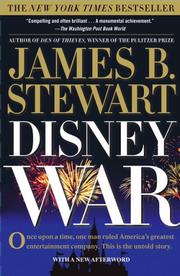
DisneyWar
The Eisner years and the boardroom war that ended them.
Summary
Stewart had extensive access to Disney and to Michael Eisner during the period covered, and produced a detailed corporate history of Eisner's twenty years as chief executive, ending with the shareholder revolt led by Roy E. Disney and Stanley Gold and Eisner's departure in 2005.
The first part covers the genuine turnaround: Eisner and Frank Wells revived the animation studio, built the theatrical film business under Jeffrey Katzenberg, expanded the parks and raised the company's value enormously. The second part covers what happened after Wells died in 1994, which Stewart treats as the turning point. Eisner lost his counterweight, refused to make Katzenberg president, and the resulting departure produced DreamWorks and a lawsuit. The Michael Ovitz hiring and the 140 million dollar severance fourteen months later became the central exhibit in the Delaware litigation over board oversight. The relationship with Pixar broke down. The ABC acquisition underperformed. The board was populated with people whose independence was compromised by consulting arrangements and personal ties.
For directors and investors this is one of the best available case studies in succession failure and board capture. Stewart shows concretely how a chief executive can neutralise a board through appointments, information control and the framing of alternatives. The book is long, dense with meeting detail, and unmistakably shaped by Stewart's judgement that Eisner's later years were destructive. Eisner disputed the account, and readers should note that the company Eisner left performed well afterwards under a successor he had opposed.
Key takeaways 7
- Eisner's early success depended on Frank Wells as an operating partner and a constraint, and the deterioration began immediately after Wells died.
- A chief executive can neutralise a board by controlling director appointments, structuring the information the board sees, and framing decisions as binary.
- The Ovitz hiring and severance demonstrated that Delaware law imposed almost no practical liability on directors who failed to ask obvious questions.
- Succession failure at Disney was deliberate, because Eisner removed each potential successor rather than developing one.
- Creative businesses depend on specific individuals and relationships, and the Pixar breakdown showed that a distribution advantage does not survive alienating the producer.
- Long chief executive tenures degrade because the board that appointed the chief executive is eventually the board the chief executive appointed.
- Shareholder activism directed at governance rather than at strategy can succeed when it recruits a founding family member with public legitimacy.
Who should read it
Directors, investors and executives who want a detailed case study of board capture, succession failure and the limits of governance law.
Where it sits in the reference 4
Who recommended it 1
Similar books 6
Chosen by shared topics, the entries that hold them, and the people who recommended both.