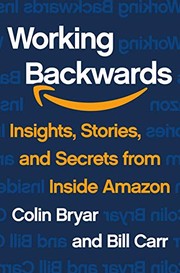
Working Backwards
Insider account by two long-serving executives; the mechanisms manual.
Summary
Bryar and Carr were Amazon executives for a combined twenty-seven years, and Bryar served as Bezos' technical adviser, a role in which he shadowed him for two years. The book documents Amazon's operating mechanisms rather than its history. The leadership principles are covered as operating instruments rather than as values, with specific accounts of how they are used in hiring, in performance evaluation and in decisions. The bar raiser process for hiring assigns a trained interviewer from outside the hiring team with authority to veto, which removes the hiring manager's incentive to fill the role quickly.
The single-threaded leader concept holds that a significant initiative requires one person whose only job is that initiative, and the separable teams structure gives each team its own resources and interfaces so that dependencies do not accumulate. The narrative process replaced presentations with six-page documents read in silence at the start of the meeting, which the authors argue forces complete reasoning that slides permit people to conceal.
Working backwards means writing the press release and the frequently asked questions for a product before building it, which forces the team to state what the customer benefit is and to confront the difficult questions before any resources are committed. The metrics material covers input metrics that a team can control rather than output metrics that follow, and the weekly business review structure.
The book is written by former executives and is favourable throughout. It says almost nothing about labour conditions or about the failures. The mechanisms are described concretely enough to implement, which is what distinguishes it from most accounts of the company.
Key takeaways 8
- A significant initiative requires a single-threaded leader whose only responsibility is that initiative, since divided attention is what kills them.
- Teams should be structured with their own resources and clean interfaces so that dependencies between them do not accumulate.
- Hiring decisions include a trained interviewer from outside the team with veto authority, which removes the manager's incentive to fill a role quickly.
- Six-page written narratives read in silence at the start of a meeting force complete reasoning that presentation slides allow people to conceal.
- Writing the press release and the customer questions before building a product forces the team to state the benefit and confront the hard questions first.
- Input metrics that a team controls should be managed, and output metrics follow from them rather than being manageable directly.
- Controllable input metrics must be identified precisely, and choosing the wrong ones produces effort directed at things that do not move the outcome.
- The book is written by former executives, is favourable throughout, and says almost nothing about labour conditions or about the company's failures.
Who should read it
Executives who want Amazon's specific operating mechanisms described concretely enough to implement rather than a narrative about the company.
Where it sits in the reference 5
Who recommended it 1
Similar books 6
Chosen by shared topics, the entries that hold them, and the people who recommended both.