 F
Podcast · 4 episodes in the reference, 2024 to 2026
First Principles
Published by The Ken
Host
AWAdrian Wells
Episodes
 Daniel Ek: How A 23 Year Old Introvert Built Spotify Into A $31 Billion Empire | Daniel Ek | 15 November 2026 | 33 min | What if the biggest tech disruption in history started with a 23-year-old introvert who couldn't get record labels to return his calls? Daniel Ek turned his bedroom coding sessions into Spotify, a $31 billion empire that solved music piracy by making stealing music less convenient than just paying for it. In this episode, Adrian Wells breaks down how Ek's introverted nature became his secret weapon for building one of the most successful platforms ever created. 🎯 What You'll Learn: • How Ek made $50,000 by age 18 building websites (while most teens were figuring out MySpace) • The 2-year persistence strategy that convinced stubborn record executives to license their catalogs • Why Spotify's freemium model converts 25% of free users when most companies struggle to hit 5% • The counterintuitive reason being an introvert helped Ek outmaneuver flashier competitors 👤 Perfect for: lifelong learners and anyone passionate about personal growth who wants to see how unconventional thinking beats conventional wisdom. 📍 Chapters: [00:00] Adrian Wells introduces the bedroom coder who changed music forever [01:45] From $5,000 teenage websites to million-dollar ideas [03:30] Why every record label said no (and how Ek kept going anyway) [06:00] The freemium psychology that competitors completely missed [08:15] How introversion became Ek's competitive advantage [10:30] Three thinking patterns you can steal from Spotify's playbook This isn't another "hustle harder" startup story. |
| Eric Weinstein: The Hidden Tech That Could Save Us Is Being Buried | Eric Weinstein | 1 November 2026 | 19 min | What if the most important technologies that could save humanity are being deliberately buried by the people who claim to protect us? In this eye-opening episode, Adrian Wells sits down with Eric Weinstein to expose the hidden power structures suppressing breakthrough innovations while we watch civilization teeter on the edge. 🎯 What You'll Learn: • Why over 5,000 patents get classified by the US government every single year under secrecy orders • How major tech giants like Google and Facebook maintain deep intelligence agency connections through contracts most people never hear about • The shocking reason nuclear weapons technology hasn't evolved since the 1960s despite billions in research funding • Eric's framework for recognizing when you're being fed manufactured narratives versus actual truth 👤 Perfect for: lifelong learners and anyone passionate about personal growth who wants to understand the real forces shaping our world behind the scenes. 📍 Chapters: [00:00] Adrian Wells introduces the technologies being hidden from us [01:30] The government's post-WWII physics research lockdown [04:00] 5,000 patents classified annually: what they don't want you to build [07:00] Big Tech's intelligence connections: the contracts that change everything [10:00] Why breakthrough energy and propulsion research gets buried [12:00] How to spot suppressed innovation in your own field This isn't conspiracy theory territory. |
 Part 2: Manav Garg sold his business and started TogetherFund with Girish Mathrubootham. Naturally, the $150M fund has a founder-operator bias. What does that mean? | Manav Garg, Girish Mathrubootham | 6 June 2024 | 1:07 | In the first part of my conversation with Manav Garg, I introduced him as the founder of Eka Software. This week, I would like to reintroduce Manav as a venture capitalist and the co-founder of Together Fund, a VC firm. Well, you know how I feel about having venture capitalists on First Principles if you've listened to my conversation with Alok Mittal. I had said in that conversation that venture capitalists are facilitators or enablers, not builders or doers. Manav, too, like Alok Mittal earlier, has been at both ends, being a facilitator and also being in the thick of building an organisation. A few months ago, he fully transitioned into being a venture capitalist and has raised almost $150 million for Together Fund's Fund II(Fund Two), which is almost double the $85 million they raised for their first fund. Manav terms Together as a founder and 'operator-led' firm, and that distinguishes it from other VC funds. Manav explained it as, "So we are the people who can, you know, roll our sleeves with them and really help them where they can really think like founders. And our concept was repetition over returns. We want to really think for the founders with empathy and really help them build a global company." If Alok Mittal's story was about turning from a VC to a founder, Manav's is about turning from a founder to a VC. Well, he is sort of both as a co-founder of Together Fund. But the question is, can a founder be a better VC than, well, a VC? |
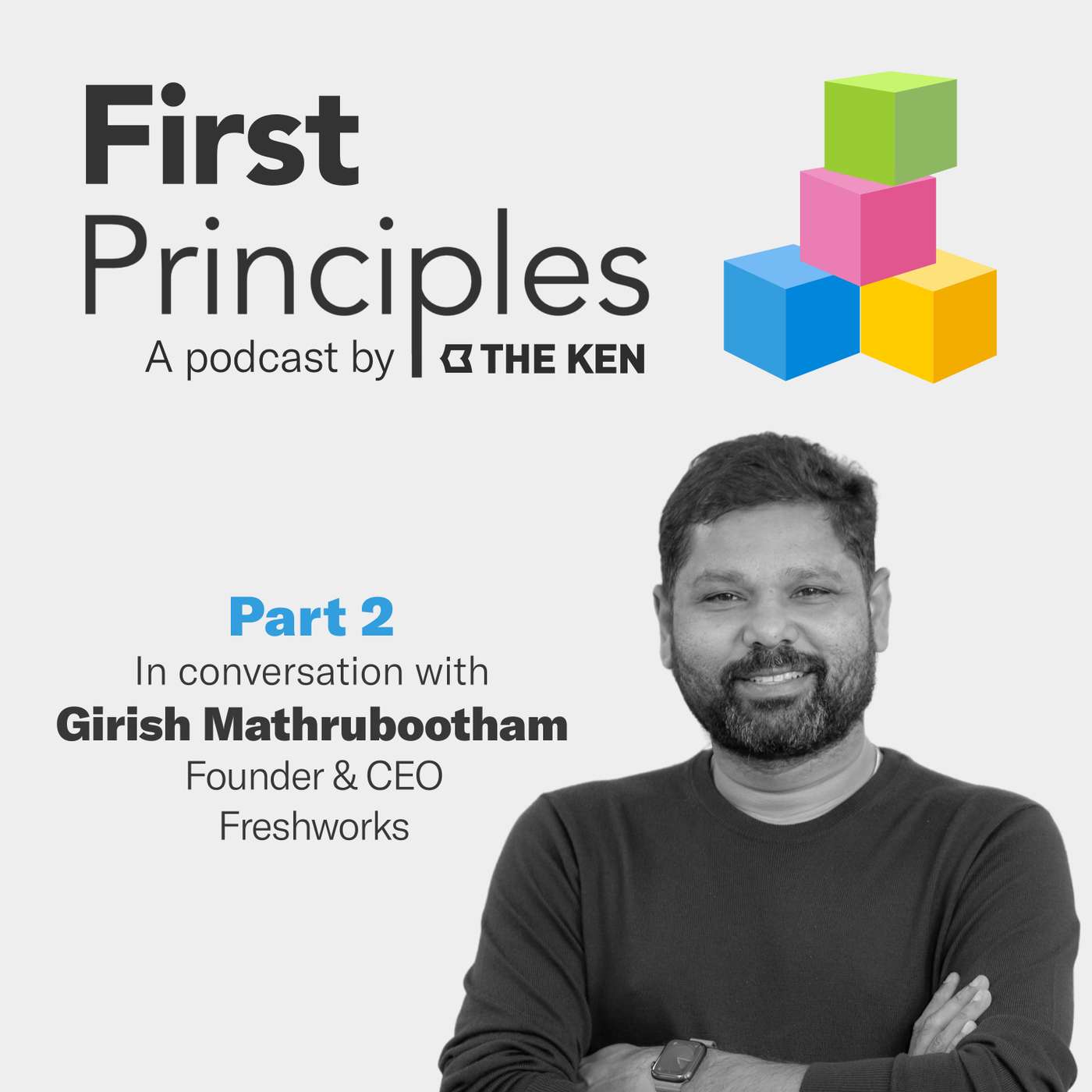 Part 2: Girish Mathrubootham on Freshworks' trade secrets – and why he opened them up to competitors | Girish Mathrubootham | 21 March 2024 | 34 min | Girish Mathrubootham – founder and CEO of Freshworks – feels strongly about having the authority to take one’s own decisions, from a young age. He made a very apt example in our conversation with him earlier this month at his office in Chennai: a kid never gets to make his own decisions, even if it is to just order food of their liking. This in turn translates into their adulthood as an inability to make decisions. Girish has been out there making most of his decisions for himself from a young age, including which school he would go to, which college he’ll enrol in and having a say in most of his major life decisions. The biggest learning he got out of this: understanding the consequences of your actions and reflecting on them to see the untapped opportunities that lay ahead. And once he got good at that, he became adept at learning so that he could do something about the untapped opportunities. Girish isn’t just the CEO of a NASDAQ-listed SaaS company, he’s also deeply involved in SaaSBoomi, a community that calls itself The World’s Largest Pay-it-forward Community of SaaS Founders. As one of SaaSboomi’s founding members, Girish played a big role in shaping its culture of openness and paying it forward. He did it by sharing in detail the methods and tactics that got a young Freshworks to $1M in annual revenue. Then, a few years later – as he explained – he took Freshworks from $1M to $5M. |
FDaniel Ek: How A 23 Year Old Introvert Built Spotify Into A $31 Billion EmpireDaniel Ek · 15 November 2026FEric Weinstein: The Hidden Tech That Could Save Us Is Being BuriedEric Weinstein · 1 November 2026FPart 2: Manav Garg sold his business and started TogetherFund with Girish Mathrubootham. Naturally, the $150M fund has a founder-operator bias. What does that mean?Manav Garg, Girish Mathrubootham · 6 June 2024FPart 2: Girish Mathrubootham on Freshworks' trade secrets – and why he opened them up to competitorsGirish Mathrubootham · 21 March 2024