 T
Podcast · 8 episodes in the reference, 2020 to 2026
The Michael Shermer Show
Published by Michael Shermer
Host
MSMichael Shermer
Episodes
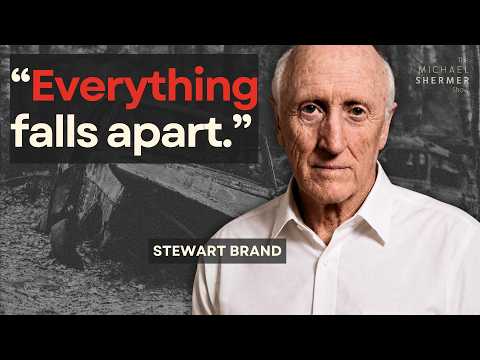 Why Everything Falls Apart—And How to Keep It Going (Stewart Brand) | Stewart Brand | 5 May 2026 | 1:04 | Stewart Brand has spent a lifetime thinking about tools, systems, civilization, and the long future. Best known as the creator of the Whole Earth Catalog and co-founder of the Long Now Foundation, Brand joins Michael Shermer to discuss his new book, Maintenance of Everything , a sweeping look at what it takes to keep bodies, machines, buildings, institutions, planets, and civilizations from falling apart. The conversation ranges from the hidden work of maintenance to electric vehicles, bicycles, nuclear power, AI, and even human populations. Brand makes the case that life itself is maintenance: everything alive must keep itself going, and everything humans build must be repaired, improved, updated, and cared for. Stewart Brand is the cofounder and president of The Long Now Foundation and cofounder of Global Business Network, the Hackers Conference, and the WELL. He created and edited the National Book Award-winning Whole Earth Catalog from 1968 to 1998. He was the subject of the documentary We Are As Gods (2020). He graduated from Stanford with a degree in biology and served as an infantry officer in the US Army. His new book is Maintenance of Everything . |
| 256. Imagining the Future with Reality Game Designer and Futurist Jane McGonigal | Jane McGonigal | 22 March 2022 | 1:10 | Shermer speaks with world-renowned future forecaster and game designer, Jane McGonigal, about her book Imaginable in which she draws on the latest scientific research in psychology and neuroscience to show us how to train our minds to think the unthinkable and imagine the unimaginable by inviting us to play with provocative thought experiments and future simulations. Shermer and McGonigal discuss: what a futurist is and what they do; counterfactuals: predicting the past; how could the present moment be different?; how can you imagine the unimaginable, or think the unthinkable?; how to envision what our lives will look like ten years from now; how to to solve problems creatively; how to make decisions that will help shape the future we desire; how to simulate any future you want; simulations as thought experiments as counterfactual causality tests; gaming as simulation of problem solving; the 10,000-hour rule for success; your present self vs. your future self and why most of us discount the future too much. |
 Matt Ridley on the Search for the Origin of COVID-19 | Matt Ridley | 11 December 2021 | 1:17 | A new virus descended on the human species in 2019 wreaking unprecedented havoc. Finding out where it came from and how it first jumped into people is an urgent priority, but early expectations that this would prove an easy question to answer have been dashed. Nearly two years into the pandemic, the crucial mystery of the origin of SARS-CoV-2 is not only unresolved but has deepened. In this conversation based on the uniquely insightful book, Viral: The Search for the Origin of COVID-19 , Matt Ridley reviews how he and his co-author Alina Chan have tried to get to the bottom of how a virus whose closest relations live in bats in subtropical southern China somehow managed to begin spreading among people more than 1,500 kilometers away in the city of Wuhan. They grapple with the baffling fact that the virus left none of the expected traces that such outbreaks usually create: no infected market animals or wildlife, no chains of early cases in travelers to the city, no smoldering epidemic in a rural area, no rapid adaptation of the virus to its new host — human beings. To try to solve this pressing mystery, Ridley delves deep into the events of 2019 leading up to 2021, the details of what went on in animal markets and virology laboratories, the records and data hidden from sight within archived Chinese theses and websites, and the clues that can be coaxed from the very text of the virus's own genetic code. |
 Michael Shermer with Julia Galef: The Scout Mindset | Julia Galef | 21 August 2021 | 1:47 | When it comes to what we believe, humans see what they want to see. We have what Julia Galef calls a "soldier" mindset: a drive to defend the ideas we most want to believe — and shoot down those we don't. But if we want to get things right more often, argues Galef, we should train ourselves to have a "scout" mindset. Unlike the soldier, a scout's goal isn't to defend one side over the other. It's to go out, survey the territory, and come back with as accurate a map as possible. Regardless of what they hope to be the case, above all, the scout wants to know what's actually true. In The Scout Mindset , Galef explores why our brains deceive us and what we can do to change the way we think. |
 Daniel Kahneman — Noise: A Flaw in Human Judgment | Daniel Kahneman | 19 June 2021 | 1:41 | Imagine that two doctors in the same city give different diagnoses to identical patients. Now imagine that the same doctor making a different decision depending on whether it is morning or afternoon, or Monday rather than Wednesday. This is an example of noise: variability in judgments that should be identical. Shermer speaks with Nobel Prize winning psychologist and economist Daniel Kahneman about the detrimental effects of noise and what we can do to reduce both noise and bias, and make better decisions in: medicine, law, economic forecasting, forensic science, bail, child protection, strategy, performance reviews, and personnel selection. |
 Robert Cialdini — Influence: The Psychology of Persuasion | Robert B. Cialdini | 8 June 2021 | 1:56 | In this dialogue, based on the new edition of his highly acclaimed bestseller (over 5 million copies sold in over 40 languages), Robert Cialdini — New York Times bestselling author of Pre-Suasion and the seminal expert in the fields of influence and persuasion — explains the psychology of why people say yes and how to apply these insights ethically in business and everyday settings. Shermer and Cialdini discuss: Cialdini's Universal Principles of Influence and 7 Principles of Persuasion, pluralistic ignorance, free will/determinism, cults, conformity, #BLM, #metoo, antiracism, social justice, and human rights. How rational are humans? Do we default to truth and naturally believe what people tell us? Are we natural-born skeptics or natural-born sheep? |
 Doom: The Politics of Catastrophe (Michael Shermer with Niall Ferguson) | Niall Ferguson | 8 May 2021 | 1:39 | Disasters are inherently hard to predict. Pandemics, like earthquakes, wildfires, financial crises, and wars, are not normally distributed; there is no cycle of history to help us anticipate the next catastrophe. In this episode, Michael Shermer speaks with one of the world's most renowned historians, Niall Ferguson, who explains why our ever more bureaucratic and complex systems are making us worse, not better, at handling disasters. |
 Michael Shermer with Matt Ridley — How Innovation Works: and Why It Flourishes in Freedom | Matt Ridley | 26 May 2020 | 1:35 | Innovation is the main event of the modern age, the reason we experience both dramatic improvements in our living standards and unsettling changes in our society. Forget short-term symptoms like Donald Trump and Brexit, it is innovation itself that explains them and that will itself shape the 21st century for good and ill. Yet innovation remains a mysterious process, poorly understood by policy makers and businessmen, hard to summon into existence to order, yet inevitable and inexorable when it does happen. In his new book, How Innovation Works , Matt Ridley argues that we need to change the way we think about innovation, to see it as an incremental, bottom-up, fortuitous process that happens to society as a direct result of the human habit of exchange, rather than an orderly, top-down process developing according to a plan. Innovation is crucially different from invention, because it is the turning of inventions into things of practical and affordable use to people. It speeds up in some sectors and slows down in others. It is always a collective, collaborative phenomenon, not a matter of lonely genius. It is gradual, serendipitous, recombinant, inexorable, contagious, experimental and unpredictable. It happens mainly in just a few parts of the world at any one time. It still cannot be modelled properly by economists, but it can easily be discouraged by politicians. Far from there being too much innovation, we may be on the brink of an innovation famine. |
TWhy Everything Falls Apart—And How to Keep It Going (Stewart Brand)Stewart Brand · 5 May 2026T256. Imagining the Future with Reality Game Designer and Futurist Jane McGonigalJane McGonigal · 22 March 2022TMatt Ridley on the Search for the Origin of COVID-19Matt Ridley · 11 December 2021TMichael Shermer with Julia Galef: The Scout MindsetJulia Galef · 21 August 2021TDaniel Kahneman — Noise: A Flaw in Human JudgmentDaniel Kahneman · 19 June 2021TRobert Cialdini — Influence: The Psychology of PersuasionRobert B. Cialdini · 8 June 2021TDoom: The Politics of Catastrophe (Michael Shermer with Niall Ferguson)Niall Ferguson · 8 May 2021TMichael Shermer with Matt Ridley — How Innovation Works: and Why It Flourishes in FreedomMatt Ridley · 26 May 2020