Updates

  1. Person pages list letters, writing, profiles and links as sortable tables with filters, and show each person's companies as links; Fund letters show each letter's description in its own column.
  2. Experts show a checked job title and a short description of each person; 30 more people have photographs.
  3. Every company, fund, university and publication the experts work for has a page listing the people there.
  4. Fund letters show each letter's thesis and filter by it; 225 person pages list the essays, columns and newsletter issues the person wrote.
  5. Person pages list every essay and newsletter issue a person wrote, and their own books as a table in List view.
  6. Recommends shows the five largest kinds of book and the rest under More; browse pictures load sooner.
  7. Podcasts and talks link the original episode, filter by Audio and video or Press, and list each publisher once.
  8. Pages are wider, Recommends has List and Grid, and a filter clicked again turns off.
  9. Book cards sit in a ruled grid with Open Library and Goodreads links and each book's one-line note.
  10. Funds is now Investors; each investor's styles are buttons that filter the table.
  11. Podcasts and talks on a person's page filter by year and publisher and show as a list or a grid of pictures.
  12. Quotes show only people's own words: 472 summaries written by list sites are gone.
  13. Country pages open from Browse again, and every link on the shelf lands on a page.
  14. Subject and person pages show their sections as tabs, and each book appears once on a person's page.
  15. Book cards show the quote, who said it and the source; grids show five cards to a row.
  16. On a phone, a menu holds the sections, search, Updates, Feedback and dark mode.
  17. Feedback takes a screenshot of the page with no browser prompt, opens a screenshot full size when you click it, and clears itself once sent.
  18. Book cards are centred, search names the topic each book sits in, and any text cut short shows whole on hover.
  19. Search groups its results by kind: people, companies, geographies, subjects, topics, books, funds, fund letters and papers.
  20. The Books table lists who recommended each book by name, and the browser tab names the section you are in.
  21. Feedback can take a screenshot of the page, or one you paste or choose, and opens in the corner beside Updates.
  22. Each rail button reopens its section where you left it, and Browse, Table and People show on every book and subject page.
  23. Filters grey out choices that hold nothing instead of hiding them, and Books › People filters by authors or recommenders.
  24. Feedback takes a subject line and up to three screenshots.
  25. Biographies are grouped by the person they are about: 41 new pages, from Abraham Lincoln to Lee Kuan Yew.
  26. Sport splits into 23 sports, and Religion into one topic per faith.
  27. Book lists show as cards: the cover, one recommendation quote and every recommender by name.
  28. Seventeen subjects that had two or three pages under different names now have one page each.
  29. Every page lists its Experts as authors and recommenders, with a link to them on the Experts tab.
  30. Economics, Financial history, Financial panics and Accounting are subjects of their own, with one page per financial crisis.
  31. Book, person and subject pages open inside the app, so the tabs stay in view.
  32. 996 more book covers, and photographs or logos for 227 more people and companies.
  33. Books › Browse shows every subject as cards, and the rail holds Fund letters, Papers, Experts, Books and Funds.
  34. Every topic over 150 books splits into narrower topics, each with a page of its own.

Send feedback

What is it?
Screenshots, up to 3 (optional)
or paste one with Ctrl+V

We use your email only to reply to you.

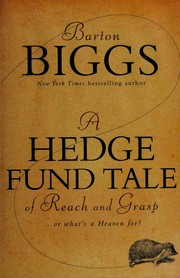
A Hedge Fund Tale of Reach and Grasp: Or Wha

A Hedge Fund Tale of Reach and Grasp: Or What's a Heaven For

Barton Biggs
2010
T4 336 pages · about 5h 36m to read Open Librarygoodreads

Wiley

Summary

Biggs, formerly of Morgan Stanley and later a hedge fund manager, wrote this novel about a young man from a modest background who works his way into the investment business, builds a successful hedge fund, and then loses it.

The fictional frame carries the content Biggs wanted to convey about the industry: how a fund is raised and marketed, the relationship between managers and their investors, the pressure of monthly and quarterly performance reporting, the effect of leverage on a manager's decisions, the psychology of a drawdown, the behaviour of fund of funds allocators who add capital after good periods and withdraw after bad ones, and the way a manager's personal life and judgement deteriorate together under sustained stress.

Biggs was a genuine industry insider and the detail about how the business operates is accurate, particularly on capital raising, on the terms and structures, and on the specific ways that investor behaviour forces managers into decisions they know are wrong.

As a novel it is weak. The characters are types, the prose is functional, and the plot follows a predictable arc. The reference has not verified whether specific episodes are drawn from actual events. Its value is as an accessible description of how the hedge fund business actually works for someone who has not been inside one, and as a portrait of the psychological pressures the structure creates. Biggs' non-fiction, particularly Hedgehogging, covers the same ground more directly.

Key takeaways 7

  1. Hedge fund investors add capital after strong periods and withdraw after weak ones, which forces managers to trade against their own judgement at the worst moments.
  2. Monthly and quarterly performance reporting compresses a manager's effective horizon far below the horizon their strategy requires.
  3. Leverage changes a manager's decisions before it changes their results, because the possibility of a forced liquidation enters every position decision.
  4. Raising capital and managing money are different skills, and the business rewards the first at least as much as the second.
  5. Fund of funds allocators optimise for their own client reporting rather than for the underlying manager's strategy, which transmits short-termism down the chain.
  6. A sustained drawdown degrades a manager's judgement and personal life together, and the two deteriorations reinforce each other.
  7. Success in the business attracts capital faster than a strategy's capacity grows, which is what converts good managers into mediocre ones.

Who should read it

Readers who want an accessible portrait of how the hedge fund business and its investor pressures actually work, though Biggs' non-fiction covers it more directly.

About Barton Biggs

Chief global strategist, Morgan Stanley 1973-2003; co-founder, Traxis Partners (1932-2012)

Thirty years of Morgan Stanley global strategy plus Hedgehogging, still the most candid insider account of how hedge fund managers actually behave.

Morgan Stanley, Traxis Partners

Who recommended it 1 · 1 direct

Similar books 6

Chosen by shared topics, the entries that hold them, and the people who recommended both.
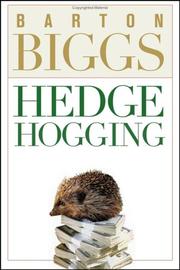
Barton Biggs · 2006

Essays and stories on the people and psychology of running a hedge fund.
Where it sits in the reference 2

Investors
Business models

Topics

FictionFinance and MarketsBusiness novels and parables