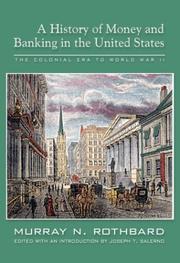
A History of Money and Banking in the United States
US money from colonial paper to the Fed, read as bank-and-state booms and busts.
The Austrian counter-history of American banking; polemical but factual.
Summary
Rothbard wrote this from an explicitly Austrian and anti-central-banking position, and it was assembled posthumously from his separate writings on American monetary history from the colonial period to the Second World War.
His interpretive framework holds that fractional reserve banking is inherently unstable and, in his view, fraudulent, because banks issue claims to money they do not hold. From this he reads American monetary history as a series of episodes in which banks and the state combined to expand credit, produced booms and consequent busts, and then used each crisis to argue for further centralisation.
The historical narrative covers colonial paper money, the First and Second Banks of the United States, Jackson's destruction of the Second Bank, the free banking era which Rothbard argues was not genuinely free because of state restrictions, the National Banking Acts and the pyramiding of reserves they created, the panics that followed, and the creation of the Federal Reserve. He treats the Federal Reserve's founding as the outcome of a campaign by large banks, particularly those associated with Morgan and Kuhn Loeb, to obtain a lender of last resort and to cartelise the industry, rather than as a response to public demand. He then argues that Federal Reserve credit expansion during the 1920s produced the 1929 crash, following Mises and Hayek's business cycle theory.
The book is polemical throughout and Rothbard makes no attempt at neutrality. Mainstream monetary historians reject the central claims: the Austrian account of the 1920s and 1929 is not supported by the monetary data, which Friedman and Schwartz read very differently, and the characterisation of fractional reserve banking as fraud is a normative position rather than an analytical finding. The account of the political interests behind the Federal Reserve's creation is closer to the historical consensus than the rest of the book.
Key takeaways 7
- Fractional reserve banking issues claims exceeding the money held, which Rothbard treats as the source of banking instability.
- The National Banking Acts pyramided reserves through correspondent relationships, which transmitted local shocks nationally.
- The free banking era was constrained by state bond collateral requirements and branching restrictions, so it did not test free banking.
- The Federal Reserve was created through a campaign by large banking interests rather than in response to public demand.
- Each banking crisis was used to argue for further centralisation, which produced the institution the crises were attributed to.
- Rothbard attributes the 1929 crash to Federal Reserve credit expansion during the 1920s, following Austrian business cycle theory.
- The book argues one position throughout and the central claims are rejected by mainstream monetary historians.
Who should read it
Readers who want the Austrian reading of American monetary history stated fully, alongside the mainstream accounts it argues against.
Similar books 6
Chosen by shared topics, the entries that hold them, and the people who recommended both.
How American monetary policy changed from the 1950s through quantitative easing.

European finance from the Middle Ages on: money, banking, markets and public debt.
The Fed from 1913 to 1951, told from its own minutes and internal memos.

The US money stock from 1867 to 1960, and how changes in it drove prices and income.
How long the dollar can remain the currency of international business.
Recommended by: Tim Ferriss
The history of money through technology, and why the financial system fails people.
Recommended by: Balaji S. Srinivasan