Updates

  1. Person pages list letters, writing, profiles and links as sortable tables with filters, and show each person's companies as links; Fund letters show each letter's description in its own column.
  2. Experts show a checked job title and a short description of each person; 30 more people have photographs.
  3. Every company, fund, university and publication the experts work for has a page listing the people there.
  4. Fund letters show each letter's thesis and filter by it; 225 person pages list the essays, columns and newsletter issues the person wrote.
  5. Person pages list every essay and newsletter issue a person wrote, and their own books as a table in List view.
  6. Recommends shows the five largest kinds of book and the rest under More; browse pictures load sooner.
  7. Podcasts and talks link the original episode, filter by Audio and video or Press, and list each publisher once.
  8. Pages are wider, Recommends has List and Grid, and a filter clicked again turns off.
  9. Book cards sit in a ruled grid with Open Library and Goodreads links and each book's one-line note.
  10. Funds is now Investors; each investor's styles are buttons that filter the table.
  11. Podcasts and talks on a person's page filter by year and publisher and show as a list or a grid of pictures.
  12. Quotes show only people's own words: 472 summaries written by list sites are gone.
  13. Country pages open from Browse again, and every link on the shelf lands on a page.
  14. Subject and person pages show their sections as tabs, and each book appears once on a person's page.
  15. Book cards show the quote, who said it and the source; grids show five cards to a row.
  16. On a phone, a menu holds the sections, search, Updates, Feedback and dark mode.
  17. Feedback takes a screenshot of the page with no browser prompt, opens a screenshot full size when you click it, and clears itself once sent.
  18. Book cards are centred, search names the topic each book sits in, and any text cut short shows whole on hover.
  19. Search groups its results by kind: people, companies, geographies, subjects, topics, books, funds, fund letters and papers.
  20. The Books table lists who recommended each book by name, and the browser tab names the section you are in.
  21. Feedback can take a screenshot of the page, or one you paste or choose, and opens in the corner beside Updates.
  22. Each rail button reopens its section where you left it, and Browse, Table and People show on every book and subject page.
  23. Filters grey out choices that hold nothing instead of hiding them, and Books › People filters by authors or recommenders.
  24. Feedback takes a subject line and up to three screenshots.
  25. Biographies are grouped by the person they are about: 41 new pages, from Abraham Lincoln to Lee Kuan Yew.
  26. Sport splits into 23 sports, and Religion into one topic per faith.
  27. Book lists show as cards: the cover, one recommendation quote and every recommender by name.
  28. Seventeen subjects that had two or three pages under different names now have one page each.
  29. Every page lists its Experts as authors and recommenders, with a link to them on the Experts tab.
  30. Economics, Financial history, Financial panics and Accounting are subjects of their own, with one page per financial crisis.
  31. Book, person and subject pages open inside the app, so the tabs stay in view.
  32. 996 more book covers, and photographs or logos for 227 more people and companies.
  33. Books › Browse shows every subject as cards, and the rail holds Fund letters, Papers, Experts, Books and Funds.
  34. Every topic over 150 books splits into narrower topics, each with a page of its own.

Send feedback

What is it?
Screenshots, up to 3 (optional)
or paste one with Ctrl+V

We use your email only to reply to you.

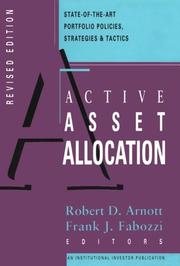
Active Asset Allocation: State-of-the-Art Po

Active Asset Allocation: State-of-the-Art Portfolio Policies, Strategies & Tactics

Robert D. Arnott, Frank J. Fabozzi
1992
T2 425 pages · about 7h 5m to read Open Librarygoodreads

Summary

The reference has not verified this book in detail; the summary states only what the title, author and subject establish.

Fabozzi edited this collection of contributions on asset allocation, covering the analytical methods and the strategies practitioners were using at the time. The reference has not verified the individual chapters.

The subject covers the decision about how to divide a portfolio among asset classes, which the literature consistently finds explains most of the variation in portfolio returns over time. The analytical territory includes mean-variance optimisation and its practical problems, particularly the sensitivity of the resulting weights to small changes in estimated expected returns; the estimation of the inputs, which is where the difficulty actually sits; approaches that reduce estimation error including shrinkage estimators, resampling and the Black-Litterman method that combines market equilibrium weights with investor views; and the distinction between strategic allocation set for the long term and tactical deviation from it.

Active allocation specifically means varying the weights in response to changing expectations about asset class returns, which requires both a forecasting method and a discipline for acting on it. The contributions would cover valuation-based approaches, momentum and trend approaches, and the risk management of an allocation that changes.

The related territory includes dynamic strategies such as constant proportion portfolio insurance, rebalancing policies and their return contribution, and the implementation of allocation decisions through derivatives rather than through cash markets.

Readers should consult the table of contents to identify the chapters relevant to their purpose, and should note that the practical toolkit has changed substantially with the availability of low-cost index instruments and with the development of risk parity and factor-based allocation approaches.

Key takeaways 7

  1. Asset allocation explains most of the variation in a portfolio's returns over time, which is why the decision dominates security selection.
  2. Mean-variance optimisation produces weights extremely sensitive to small changes in estimated expected returns, which makes raw application unusable.
  3. The difficulty in allocation is estimating the inputs rather than performing the optimisation.
  4. Methods including shrinkage, resampling and combining market equilibrium with investor views exist to reduce the effect of estimation error.
  5. Strategic allocation set for the long term and tactical deviation from it are distinct decisions requiring different justification.
  6. Rebalancing policy itself contributes to returns and should be set deliberately rather than left to convention.
  7. Allocation changes can be implemented through derivatives at lower cost and faster than through cash market transactions.

Who should read it

Practitioners working on portfolio allocation who need a reference on the methods, verified against the current toolkit.

About Robert D. Arnott

Founder and Chairman, Research Affiliates (rebranded Syzygy Asset Management, 2026); former CEO of First Quadrant; former editor of the Financial Analysts Journal

Fundamental Indexation launched the smart-beta industry and The Fundamental Index turned it into a book that outlived its news cycle, on top of a long asset-management record.

Research Affiliates, First Quadrant, Financial Analysts Journal

Similar books 6

Chosen by shared topics, the entries that hold them, and the people who recommended both.

Frank J. Fabozzi · 1989

The standard text on bonds: instruments, valuation, risk and portfolio strategy.
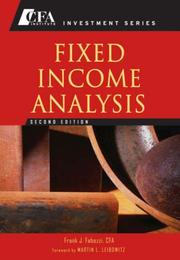
Frank J. Fabozzi, Barbara S. Petitt, Jerald E. Pinto, Wendy L. Pirie · 2007

The CFA Institute's fixed-income text: bond valuation, risk and analysis.

John Brynjolfsson, Frank J. Fabozzi · 1999

Essays on inflation-indexed bonds, written as the US TIPS market opened.

Frank J. Fabozzi · 2010

A handbook chapter on nonconvertible preferred stock as a fixed-income security.

Frank J. Fabozzi · 2004

Academic essays on how short selling works and what the evidence shows.

Where it sits in the reference 2

Investors
Academics

Topics

Investing