Updates

  1. Person pages list letters, writing, profiles and links as sortable tables with filters, and show each person's companies as links; Fund letters show each letter's description in its own column.
  2. Experts show a checked job title and a short description of each person; 30 more people have photographs.
  3. Every company, fund, university and publication the experts work for has a page listing the people there.
  4. Fund letters show each letter's thesis and filter by it; 225 person pages list the essays, columns and newsletter issues the person wrote.
  5. Person pages list every essay and newsletter issue a person wrote, and their own books as a table in List view.
  6. Recommends shows the five largest kinds of book and the rest under More; browse pictures load sooner.
  7. Podcasts and talks link the original episode, filter by Audio and video or Press, and list each publisher once.
  8. Pages are wider, Recommends has List and Grid, and a filter clicked again turns off.
  9. Book cards sit in a ruled grid with Open Library and Goodreads links and each book's one-line note.
  10. Funds is now Investors; each investor's styles are buttons that filter the table.
  11. Podcasts and talks on a person's page filter by year and publisher and show as a list or a grid of pictures.
  12. Quotes show only people's own words: 472 summaries written by list sites are gone.
  13. Country pages open from Browse again, and every link on the shelf lands on a page.
  14. Subject and person pages show their sections as tabs, and each book appears once on a person's page.
  15. Book cards show the quote, who said it and the source; grids show five cards to a row.
  16. On a phone, a menu holds the sections, search, Updates, Feedback and dark mode.
  17. Feedback takes a screenshot of the page with no browser prompt, opens a screenshot full size when you click it, and clears itself once sent.
  18. Book cards are centred, search names the topic each book sits in, and any text cut short shows whole on hover.
  19. Search groups its results by kind: people, companies, geographies, subjects, topics, books, funds, fund letters and papers.
  20. The Books table lists who recommended each book by name, and the browser tab names the section you are in.
  21. Feedback can take a screenshot of the page, or one you paste or choose, and opens in the corner beside Updates.
  22. Each rail button reopens its section where you left it, and Browse, Table and People show on every book and subject page.
  23. Filters grey out choices that hold nothing instead of hiding them, and Books › People filters by authors or recommenders.
  24. Feedback takes a subject line and up to three screenshots.
  25. Biographies are grouped by the person they are about: 41 new pages, from Abraham Lincoln to Lee Kuan Yew.
  26. Sport splits into 23 sports, and Religion into one topic per faith.
  27. Book lists show as cards: the cover, one recommendation quote and every recommender by name.
  28. Seventeen subjects that had two or three pages under different names now have one page each.
  29. Every page lists its Experts as authors and recommenders, with a link to them on the Experts tab.
  30. Economics, Financial history, Financial panics and Accounting are subjects of their own, with one page per financial crisis.
  31. Book, person and subject pages open inside the app, so the tabs stay in view.
  32. 996 more book covers, and photographs or logos for 227 more people and companies.
  33. Books › Browse shows every subject as cards, and the rail holds Fund letters, Papers, Experts, Books and Funds.
  34. Every topic over 150 books splits into narrower topics, each with a page of its own.

Send feedback

What is it?
Screenshots, up to 3 (optional)
or paste one with Ctrl+V

We use your email only to reply to you.

FJ

Frank J. Fabozzi

Has edited The Journal of Portfolio Management since 1986 and written or edited many finance books, three with Nobel laureates Franco Modigliani and Harry Markowitz; taught at Yale and MIT.

Johns Hopkins Carey Business SchoolThe Journal of Portfolio Management

The handbooks define how bond, mortgage and preferred-stock markets are measured: cash-flow mechanics, duration and convexity, credit structures, and the pricing conventions desks actually use. Practitioners and CFA candidates work through these volumes to value and hedge the instruments the equity literature skips.

11 books of their own · 108 articles · 1 appearance

Start here

  1. The Handbook of Fixed Income SecuritiesFrank J. Fabozzi, 1983
  2. Bond Markets, Analysis, and StrategiesFrank J. Fabozzi, 1989
  3. Fixed Income AnalysisFrank J. Fabozzi, Barbara S. Petitt, Jerald E. Pinto, Wendy L. Pirie, 2007
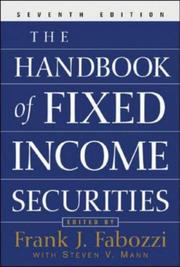
Frank J. Fabozzi · 1983

The standard reference on every kind of bond, its analysis and its management.
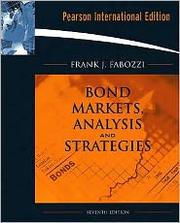
Frank J. Fabozzi · 1989

The standard text on bonds: instruments, valuation, risk and portfolio strategy.
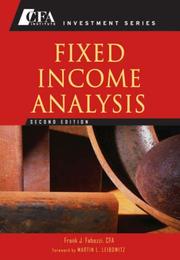
Frank J. Fabozzi, Barbara S. Petitt, Jerald E. Pinto, Wendy L. Pirie · 2007

The CFA Institute's fixed-income text: bond valuation, risk and analysis.
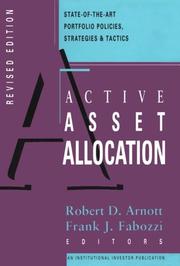
Frank J. Fabozzi · 1992

Portfolio insurance, optimisation, surplus management and tactical asset allocation.
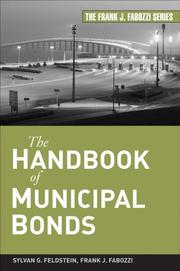
Sylvan G. Feldstein, Frank J. Fabozzi · 2008

A reference on municipal bonds: credit analysis, structures and analytics.

John Brynjolfsson, Frank J. Fabozzi · 1999

Essays on inflation-indexed bonds, written as the US TIPS market opened.
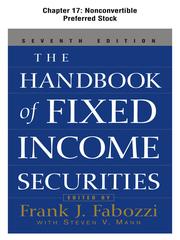
Frank J. Fabozzi · 2010

A handbook chapter on nonconvertible preferred stock as a fixed-income security.
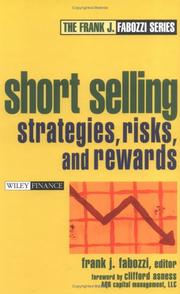
Frank J. Fabozzi · 2004

Academic essays on how short selling works and what the evidence shows.
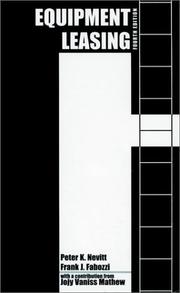
Frank J. Fabozzi, Peter K. Nevitt · 2000

Lease structures, residual values and tax treatment of equipment leasing.
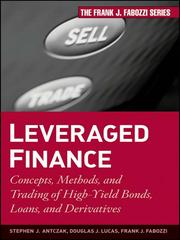
Stephen J. Antczak, Douglas J. Lucas, Frank J. Fabozzi · 2009

High-yield bonds, leveraged loans and the credit derivatives written on them.

The Handbook of Fixed Income SecuritiesThe standard reference on every kind of bond, its analysis and its management.1983T2–
Bond Markets, Analysis, and StrategiesThe standard text on bonds: instruments, valuation, risk and portfolio strategy.1989T2–
Fixed Income AnalysisThe CFA Institute's fixed-income text: bond valuation, risk and analysis.2007T2–
Asset Allocation: A Handbook of Portfolio Policies, Strategies and Tactics–1988T2–
Active Asset Allocation: State-of-the-Art Portfolio Policies, Strategies & TacticsPortfolio insurance, optimisation, surplus management and tactical asset allocation.1992T2–
The Handbook of Municipal BondsA reference on municipal bonds: credit analysis, structures and analytics.2008T2–
Handbook of Inflation Indexed BondsEssays on inflation-indexed bonds, written as the US TIPS market opened.1999T2–
Nonconvertible Preferred StockA handbook chapter on nonconvertible preferred stock as a fixed-income security.2010T2–
Short SellingAcademic essays on how short selling works and what the evidence shows.2004T2–
Equipment LeasingLease structures, residual values and tax treatment of equipment leasing.2000T2–
Leveraged FinanceHigh-yield bonds, leveraged loans and the credit derivatives written on them.2009T3–

Tags

bondscreditstructured-financefixed-incomeduration-and-convexityportfolio-constructionasset-allocationmunicipal-bondsshort-selling