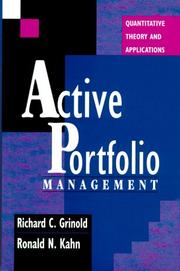
Active Portfolio Management
The quantitative method for building active portfolios against a benchmark.
The fundamental law of active management; the quantitative manager's reference.
Summary
Grinold and Kahn, both from Barra and later BlackRock, wrote the standard quantitative text on constructing and managing active portfolios against a benchmark.
The framework is built on residual return, meaning return in excess of the benchmark after adjusting for beta, and residual risk, meaning the volatility of that excess. The information ratio is the ratio of expected residual return to residual risk, and Grinold and Kahn argue it is the correct measure of a manager's skill because it is independent of the amount of risk taken. A manager's value added is then the information ratio squared divided by four times the risk aversion, which means the information ratio determines everything and the risk level is a separate choice.
The fundamental law of active management is the book's best-known result. The information ratio approximately equals the information coefficient, meaning the correlation between forecast and realised residual returns, multiplied by the square root of breadth, meaning the number of independent bets made per year. The implication is that a manager with very modest forecasting ability can achieve a high information ratio by making many independent bets, and that a manager with excellent insight applied to few positions cannot. The law also explains why breadth must be genuinely independent, since correlated bets do not count separately.
The book then develops the machinery: forecasting returns and converting raw signals into expected returns through the refinement process, multi-factor risk models, portfolio construction through optimisation with constraints, transaction cost modelling, and performance analysis that decomposes returns into their sources.
The mathematics is demanding and the book assumes statistics and portfolio theory. The fundamental law is an approximation that requires assumptions frequently violated in practice, particularly the independence of bets and the constancy of the information coefficient, and later work has refined it with a transfer coefficient accounting for constraints. It remains the reference text for quantitative active management.
Key takeaways 7
- The information ratio, meaning expected residual return divided by residual risk, measures skill independently of how much risk a manager takes.
- The information ratio approximately equals forecasting skill multiplied by the square root of the number of independent bets.
- A manager with modest forecasting ability applied across many independent positions outperforms one with strong insight applied to few.
- Bets must be genuinely independent to count toward breadth, so correlated positions do not increase the achievable information ratio.
- Value added depends on the information ratio squared, so improving skill matters far more than adjusting risk.
- Raw forecasting signals must be scaled to expected returns, and the scaling depends on the signal's demonstrated correlation with outcomes.
- Constraints on a portfolio reduce the achievable information ratio by preventing the intended bets from being expressed.
Who should read it
Quantitative portfolio managers and allocators who need the analytical framework for active risk, skill measurement and portfolio construction.
Who recommended it 1 · 1 direct
“Richard C. Grinold and Ronald N. Kahn, Active Portfolio Management: A Quantitative Approach for Producing Superior Returns and Controlling Risk, Second Edition (New York: McGraw-Hill, 2000), 480”
Similar books 6
Chosen by shared topics, the entries that hold them, and the people who recommended both.
Markets pay skilled active managers; a survey of the strategies they run.
“Now another outstanding Nordic researcher (and AQR partner), Lasse Heje Pedersen, presents me with the same dilemma: His new book, Efficiently Inefficient (Princeton University Press), is fantastic — almost too good at laying out how successful professional asset managers think and act.” — Clifford Asness
Source: Efficient Inefficiency: The Oxymoron That Explains the Investing World
Recommended by: Clifford Asness, Michael Mauboussin
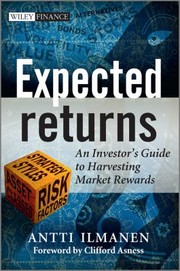
The evidence on what drives returns across asset classes: risk factors and behaviour.
“Ilmanen, Antti, Expected Returns: An Investor’s Guide to Harvesting Market Rewards (Hoboken, NJ: John Wiley & Sons, 2011)” — Michael Mauboussin
Source: Who Is On the Other Side? You Need Good BAIT to Land a Winner, page 40
Recommended by: Michael Mauboussin
Factor investing for asset owners: factors as the nutrients inside assets.
“In his 2014 text Asset Management, for example, Columbia Professor Andrew Ang opens his chapter on mutual funds with this pungent summary.” — John C. Bogle
Source: The Road Less Traveled, page 13
Recommended by: John C. Bogle, Michael Mauboussin and 1 other
How Markowitz, Sharpe, Fama, Black and Scholes built the theory of modern finance.
“But it was in his Capital Ideas, published in 1992, that I first learned of Louis Bachelier’s 1900 dissertation, The Theory of Speculation.” — John C. Bogle
Source: Success In Investment Management: What Can We Learn From Indexing?, page 1
Recommended by: John C. Bogle, Michael Mauboussin
An asset's risk depends on how it moves with the rest of the portfolio.
“Markowitz, Harry M., Portfolio Selection: Efficient Diversification of Investment (New Haven, CT: Yale University Press, 1959)” — Michael Mauboussin
Source: Size Matters: The Kelly Criterion and the Importance of Money Management, page 12
Recommended by: Michael Mauboussin, William J. Bernstein
How financial advisers can spot clients' biases and adjust their portfolios.