Updates

  1. Person pages list letters, writing, profiles and links as sortable tables with filters, and show each person's companies as links; Fund letters show each letter's description in its own column.
  2. Experts show a checked job title and a short description of each person; 30 more people have photographs.
  3. Every company, fund, university and publication the experts work for has a page listing the people there.
  4. Fund letters show each letter's thesis and filter by it; 225 person pages list the essays, columns and newsletter issues the person wrote.
  5. Person pages list every essay and newsletter issue a person wrote, and their own books as a table in List view.
  6. Recommends shows the five largest kinds of book and the rest under More; browse pictures load sooner.
  7. Podcasts and talks link the original episode, filter by Audio and video or Press, and list each publisher once.
  8. Pages are wider, Recommends has List and Grid, and a filter clicked again turns off.
  9. Book cards sit in a ruled grid with Open Library and Goodreads links and each book's one-line note.
  10. Funds is now Investors; each investor's styles are buttons that filter the table.
  11. Podcasts and talks on a person's page filter by year and publisher and show as a list or a grid of pictures.
  12. Quotes show only people's own words: 472 summaries written by list sites are gone.
  13. Country pages open from Browse again, and every link on the shelf lands on a page.
  14. Subject and person pages show their sections as tabs, and each book appears once on a person's page.
  15. Book cards show the quote, who said it and the source; grids show five cards to a row.
  16. On a phone, a menu holds the sections, search, Updates, Feedback and dark mode.
  17. Feedback takes a screenshot of the page with no browser prompt, opens a screenshot full size when you click it, and clears itself once sent.
  18. Book cards are centred, search names the topic each book sits in, and any text cut short shows whole on hover.
  19. Search groups its results by kind: people, companies, geographies, subjects, topics, books, funds, fund letters and papers.
  20. The Books table lists who recommended each book by name, and the browser tab names the section you are in.
  21. Feedback can take a screenshot of the page, or one you paste or choose, and opens in the corner beside Updates.
  22. Each rail button reopens its section where you left it, and Browse, Table and People show on every book and subject page.
  23. Filters grey out choices that hold nothing instead of hiding them, and Books › People filters by authors or recommenders.
  24. Feedback takes a subject line and up to three screenshots.
  25. Biographies are grouped by the person they are about: 41 new pages, from Abraham Lincoln to Lee Kuan Yew.
  26. Sport splits into 23 sports, and Religion into one topic per faith.
  27. Book lists show as cards: the cover, one recommendation quote and every recommender by name.
  28. Seventeen subjects that had two or three pages under different names now have one page each.
  29. Every page lists its Experts as authors and recommenders, with a link to them on the Experts tab.
  30. Economics, Financial history, Financial panics and Accounting are subjects of their own, with one page per financial crisis.
  31. Book, person and subject pages open inside the app, so the tabs stay in view.
  32. 996 more book covers, and photographs or logos for 227 more people and companies.
  33. Books › Browse shows every subject as cards, and the rail holds Fund letters, Papers, Experts, Books and Funds.
  34. Every topic over 150 books splits into narrower topics, each with a page of its own.

Send feedback

What is it?
Screenshots, up to 3 (optional)
or paste one with Ctrl+V

We use your email only to reply to you.

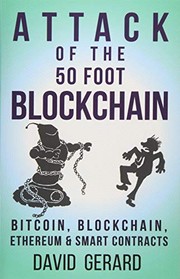
Attack of the 50 Foot Blockchain

Attack of the 50 Foot Blockchain

David Gerard
2017
T4 182 pages · about 3h 2m to read Open Librarygoodreads

The sceptic's brief against crypto claims.

Summary

Gerard, a technology writer and system administrator, wrote a short sceptical account of bitcoin, blockchain and the related industry as it stood in 2017.

The technical argument is that a blockchain solves a narrow problem, namely reaching agreement on a ledger among parties who do not trust each other and have no external authority, at enormous cost in energy and throughput, and that almost no real application has that requirement. Where a trusted party exists or can be created, a conventional database performs better in every respect. He argues that private or permissioned blockchains, which several banks were then building, are databases with extra steps, since if the participants trust each other enough to be permissioned they do not need the consensus mechanism.

The industry chapters cover bitcoin's history including the Mt Gox failure and the exchange collapses, the role of Tether and the questions about its reserves, the initial coin offering wave and the pattern of projects raising money with no product, the Ethereum DAO exploit and the fork that reversed it, and the environmental cost of proof of work.

Gerard's arguments about smart contracts are among the sharpest: a contract that executes automatically cannot be corrected when it does the wrong thing, code contains bugs, and the DAO demonstrated both.

The book is polemical and does not engage seriously with the arguments for permissionless settlement or with the use of stablecoins in countries with capital controls or unstable currencies. It is also from 2017, so it predates the subsequent cycles. Many of its specific predictions about failures, particularly on initial coin offerings and on Tether, were subsequently borne out.

Key takeaways 7

  1. A blockchain solves the narrow problem of agreeing a ledger among mutually distrusting parties with no external authority, at very high cost.
  2. Where a trusted party exists or can be established, a conventional database outperforms a blockchain on every dimension.
  3. Permissioned blockchains are databases with additional complexity, because permissioned participants do not need trustless consensus.
  4. Smart contracts execute regardless of whether the outcome is intended, and code containing bugs cannot be corrected after deployment.
  5. Proof of work consumes energy in proportion to the value being secured, which is a design property rather than an inefficiency to be optimised away.
  6. Initial coin offerings raised money against projects with no product and no obligation to deliver one.
  7. Exchange failures rather than protocol failures have accounted for nearly all losses in the sector.

Who should read it

Technologists and investors who want the technical sceptical case against blockchain applications, recognising that it argues one position.

Similar books 6

Chosen by shared topics, the entries that hold them, and the people who recommended both.
Don Tapscott, Alex Tapscott · 2016

The high-water mark of enterprise blockchain enthusiasm.
Campbell R. Harvey, Ashwin Ramachandran, Joey Santoro · 2021
Ben McKenzie, Jacob Silverman · 2023

Includes the authors' own interview with Bankman-Fried.
Andreas M. Antonopoulos · 2014

How Bitcoin works underneath: keys, addresses, transactions, mining and the network.

Recommended by: Balaji S. Srinivasan

Zeke Faux · 2023

Two years inside the 2021 crypto boom and 2022 bust, starting from Tether.

Where it sits in the reference 1

Assets

Topics

Technology and ComputingFinance and MarketsCrypto and financial technology