Deep Risk
Financial history used to treat investment risk as a problem of insurance.
Investing for Adults series, volume 3
Summary
The reference has not verified this book in detail; the summary states only what the title, author and subject establish.
Bernstein, in the third volume of his Investing for Adults series, a short book of about fifty pages, moves beyond the mean-variance definition of risk associated with Markowitz and uses financial history to treat risk as an insurance problem: the probability of a loss, its impact, and the cost of insuring against it. He measures loss by both its size and its duration. Shallow risk is a bear market or correction from which prices recover within roughly seven to ten years; an investor who can hold on through it suffers no permanent harm.
Deep risk is the permanent loss of real wealth, and he names four sources: sustained hyperinflation, sustained deflation, confiscation, including through taxes, and devastation by war or similar disaster. His historical cases show that bonds can carry more deep risk than stocks: in Germany and Japan during and after the Second World War, stock markets fell about 90 percent but recovered within ten to fifteen years, while bond holdings lost about 95 percent and became nearly worthless. The source read in this pass is a podcast discussion of the book, so his portfolio recommendations are not recorded here.
Key takeaways 4
- A loss should be judged by its duration as well as its size.
- Bear markets from which prices recover within about a decade are shallow risk, not permanent loss.
- Deep risk comes from four sources: hyperinflation, deflation, confiscation and devastation.
- Bonds can be the riskier asset in the deep sense, as German and Japanese bondholders found after the Second World War.
Who should read it
Investors who want to think about permanent loss of wealth over decades rather than short-term volatility.
About William J. Bernstein
Neurologist turned investment theorist; principal, Efficient Frontier Advisors; author and financial historian
Serious, widely cited writing on asset allocation plus economic histories that outlived their news cycle, though he has no public money-management record.
Similar books 6
Chosen by shared topics, the entries that hold them, and the people who recommended both.
A short booklet to start people in their twenties investing for retirement.
Quantitative asset allocation for small investors, built from a clean sheet of paper.
Why no magic mix of high-return, low-correlation asset classes exists.
How an investor's needs and portfolio change across the stages of life.
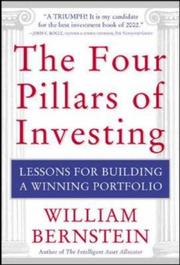
Market history, theory and behavioural finance for building a portfolio on your own.
“If you've already read and loved The Smartest Investment Book You'll Ever Read, above, then read this more in-depth book next.” — Derek Sivers
Source: Derek Sivers book notes (primary, rated list) · Rating: 6/10
Recommended by: Derek Sivers
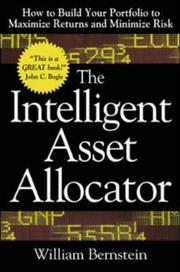
Modern portfolio theory for individual investors, explained without heavy maths.
Recommended by: The Barefoot Investor