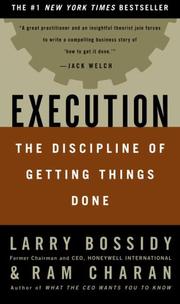
Execution: The Discipline of Getting Things Done
Execution is a discipline the CEO must lead, linking people, strategy and operations.
Operating discipline linking people, strategy and operations into one process
Summary
Bossidy ran AlliedSignal and Honeywell after a career at General Electric, and Charan is a corporate adviser. Their argument is that execution is not the tactical work left over after strategy is set, but a discipline that the chief executive must personally own, and that most strategic failure is execution failure that gets misdiagnosed as strategy failure.
The structure is three core processes that must be linked: the people process, the strategy process and the operations process. The people process is treated as primary, and Bossidy is specific that a leader should spend a large share of time on assessing, placing and developing people, and should conduct rigorous personal reviews rather than delegate them to human resources. The strategy process must be built by the people who will execute it, must be tested against explicit questions about competitive response and capability, and must produce a plan whose assumptions are stated. The operating process converts the strategy into targets with named owners and dates, with contingency plans for the assumptions that could break.
The underlying behavioural argument concerns the quality of dialogue, meaning meetings where disagreement surfaces and decisions close with a specific commitment rather than dissolving. The book is repetitive, the examples are large industrial companies from the 1990s and early 2000s, and its treatment of Honeywell's own record is generous. Bossidy's successor context and the later performance of some of the companies praised complicate the case. The core process discipline remains widely used and the people-first sequencing is the part most operators find durable.
Key takeaways 7
- Execution is a discipline that the chief executive must personally run, not a set of tactics to be delegated after strategy is set.
- The people process should precede and drive the strategy process, because a plan is only as good as the specific individuals assigned to deliver it.
- Leaders should personally conduct candid individual assessments rather than delegate them to a human resources function.
- A strategy must be built by the people who will execute it, since a plan handed down from a separate planning group will not be owned.
- Every meeting should close with a named owner, a specific action and a date, and a decision without those is not a decision.
- Strategic plans should state their assumptions explicitly so that the ones that break can be identified and replanned against.
- Leaders who avoid confronting underperformance in individuals guarantee that the organisation cannot execute, whatever its processes say.
Who should read it
Executives building an operating rhythm who want the case for treating people decisions and review discipline as the chief executive's own work.
Who recommended it 4 · 3 direct
“In-depth look at the dirty discipline of getting things done in a large organization.”
“Larry Bossidy and Ram Charan, Execution: The Discipline of Getting Things Done (New York: Crown Business, 2002), 21-23”
Similar books 6
Chosen by shared topics, the entries that hold them, and the people who recommended both.
Why teams perform when leaders give up their own interest to keep people safe.
Recommended by: Alfred Lin, Julie Stevanja, Tom Bilyeu and 1 other
What eleven companies did to turn fifteen ordinary years into fifteen great ones.
“(We invite you to read the chapter devoted to the company in the book “Good to Great”).” — Francois Rochon
Source: Giverny Capital Annual Letter to Partners 2006, page 7
Recommended by: Brian Armstrong, Francois Rochon and 20 others
How Popeyes recovered when its chief chose to lead by serving others.
Recommended by: Mohnish Pabrai
A chief executive's method for getting results, from his years running Gillette.
Recommended by: Mohnish Pabrai
How the idea of flow applies to business and leadership.
Recommended by: Mohnish Pabrai
A chief executive's advice on the art of leadership.
Recommended by: Jim Collins, Mohnish Pabrai, David Cancel