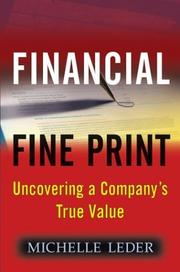
Financial Fine Print: Uncovering a Company's True Value
How to find a company's real condition in the footnotes of its filings.
Summary
Leder argues that the real clues to a company's financial health are buried in the footnotes of its quarterly (10-Q) and annual (10-K) reports. She notes that 35 million individual investors entered the stock market for the first time in the late 1990s without asking questions, and that when the bubble burst and accounting scandals spread, few knew whom to trust. At many large companies the footnotes run beyond 30 pages, and at some they doubled in five years.
The book spells out what investors should look for in those footnotes, using many examples of actual footnotes from SEC filings, in plain language. Its aim is to help investors spot and avoid the next Enron, WorldCom, Tyco, Adelphia or HealthSouth. It was published in 2003, after three years of market losses.
Key takeaways 4
- The footnotes of 10-K and 10-Q filings hold information the headline numbers leave out.
- Footnotes at large companies have grown long enough to hide problems in plain sight.
- Reading actual SEC footnotes teaches the warning signs that preceded the Enron and WorldCom collapses.
- Individual investors can do the same forensic reading that professionals do.
Who should read it
Individual investors who want to read company filings critically and catch accounting trouble early.
Who recommended it 1 · 1 direct
Similar books 6
Chosen by shared topics, the entries that hold them, and the people who recommended both.
How to analyse a company's financial statements.
Recommended by: Mohnish Pabrai
Security analysis that weighs the balance sheet over reported earnings.
Recommended by: Mohnish Pabrai
A short line-by-line primer on the balance sheet, income account and key ratios.
Recommended by: Mohnish Pabrai
How to use financial statements to value a business, from concept to practice.
How to read financial statements to judge the quality of a company's earnings.
Recommended by: Patrick O'Shaughnessy
Graham and Dodd's valuation updated for companies with few tangible assets.
Recommended by: Mohnish Pabrai