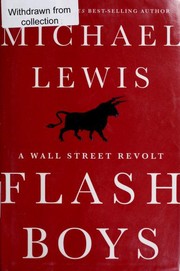
Flash Boys
How a trader uncovered high-frequency front-running and built the IEX exchange.
The IEX story and the public argument about latency arbitrage.
Summary
Lewis follows Brad Katsuyama, a Royal Bank of Canada trader who discovered that his orders were being front-run, and his effort to understand the mechanism and then to build IEX, an exchange designed to prevent it.
The mechanism Lewis describes is latency arbitrage. When a large order is routed to multiple exchanges, it arrives at the nearest one first. Firms with faster connections observe the execution there and trade ahead of the order's arrival at the other venues, moving the price against the original buyer. Lewis documents the infrastructure built for this, including a fibre line laid in a straight route between Chicago and New Jersey to reduce transmission time by a few milliseconds, and microwave towers built afterwards for the same purpose.
He also covers payment for order flow, the proliferation of order types designed to advantage particular participants, dark pools operated by banks whose interests conflicted with their clients', and the effect of Regulation NMS in creating the fragmented structure that made the arbitrage possible. IEX's response was a coil of fibre creating a delay that removed the speed advantage on incoming orders.
The book was heavily disputed. Critics argue that Lewis overstates the harm to ordinary investors, that spreads and costs have fallen substantially for retail investors, that high-frequency market making provides liquidity, and that the rigged claim is a simplification. Lewis concentrates on a single perspective and the technical description has been challenged on specifics. The description of latency arbitrage and of market fragmentation is accurate in outline.
Key takeaways 8
- A large order routed to multiple exchanges arrives at the nearest one first, which lets observers trade ahead of its arrival elsewhere.
- Firms built physical infrastructure including a straight fibre route and microwave towers to reduce transmission time by milliseconds.
- Regulation NMS created a fragmented market structure in which orders must be routed across venues, which is what made the arbitrage possible.
- Order types were created that advantage particular participants, and their existence was not widely understood even by professional traders.
- Banks operated dark pools while also routing client orders, which created a conflict most clients could not observe.
- An exchange can remove a speed advantage by introducing a deliberate delay on incoming orders, which is the mechanism IEX built.
- Payment for order flow means retail orders are sold rather than routed to the venue offering the best execution.
- Critics argue that retail trading costs have fallen substantially and that the harm Lewis describes falls on institutions rather than on ordinary investors.
Who should read it
Investors who want an account of market structure and latency arbitrage, read alongside the substantial technical criticism it received.
About Michael Lewis
Financial journalist and author; former Salomon Brothers bond salesman
Liar's Poker, The Big Short and Flash Boys are the primary narrative sources later writers build on for Wall Street of the 1980s, the subprime crisis and high-frequency trading.
Who recommended it 4 · 3 direct
“Flash Boys was a good capstone to the last week of wallowing in the global financial crisis of 2008, which I began by watching the movie The Big Short.”
Similar books 6
Chosen by shared topics, the entries that hold them, and the people who recommended both.
Market microstructure, execution algorithms and direct market access, explained.
How electronic and high-frequency trading took over American stock markets.

A trader in his parents' London house, and his link to the 2010 flash crash.

How WallStreetBets traders drove up GameStop and broke a hedge fund that shorted it.

Life on Salomon Brothers' bond trading floor in the 1980s mortgage-bond boom.
“And then "Liar's Poker" from Michael Lewis, love that. I really like - I mythologize like Lewis Ranieri and all these guys when I read it.” — Chamath Palihapitiya
Source: Transcript: Chamath Palihapitiya
Recommended by: Chamath Palihapitiya, Michael Burry and 5 others
How algorithms spread from trading into hospitals, culture and daily life.
Where it sits in the reference 2
Topics 3
As an Amazon Associate I earn from qualifying purchases.