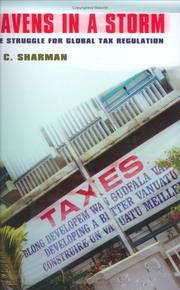
Havens in a Storm
How small tax havens defeated the OECD's campaign against harmful tax competition.
How small jurisdictions fought off the OECD's harmful tax competition drive.
Summary
Sharman, a political scientist, examined the campaign the Organisation for Economic Co-operation and Development launched in 1998 against what it called harmful tax competition, and asked why it largely failed.
The puzzle is genuine. The initiative was backed by the world's largest economies against a group of very small jurisdictions with no economic or military power, and it demanded that they exchange tax information and change their tax regimes. On any conventional account of international politics the outcome should have been immediate compliance. Instead the small states resisted successfully, the initiative was substantially narrowed, and its central demand that havens raise their tax rates was abandoned.
Sharman's explanation is rhetorical rather than material. The havens, coordinated partly through the Commonwealth Secretariat and advised by lobbyists and academics, attacked the initiative on the terms the large states themselves professed. They argued that demanding small states raise taxes contradicted the free market principles those states advocated everywhere else, that the process denied them representation while binding them, that the criteria were applied to small jurisdictions and not to comparable practices in large ones including Switzerland, Luxembourg and several American states, and that the initiative was therefore hypocritical. Because the large states could not defend the initiative in terms consistent with their own stated principles, they conceded.
The general argument is that in international regulatory politics, the ability to frame an issue in terms the powerful cannot answer without contradicting themselves can substitute for material power.
The book is academic and from 2006. The subsequent developments, including the Foreign Account Tax Compliance Act, the Common Reporting Standard and beneficial ownership registers, achieved much of what the original initiative sought, using different instruments and applied by states acting unilaterally rather than through consensus organisations.
Key takeaways 7
- A campaign by the world's largest economies against very small jurisdictions was substantially defeated by those jurisdictions.
- The havens attacked the initiative on the free market principles the large states themselves advocated everywhere else.
- Applying criteria to small jurisdictions while exempting comparable practices in large ones made the initiative indefensible in its own terms.
- Denying the targeted states representation in a process that would bind them was the procedural objection that carried weight.
- The ability to frame an issue so that the powerful cannot answer without contradicting themselves can substitute for material power.
- Large states conceded because they could not defend the initiative in terms consistent with their own stated principles.
- Later measures achieved much of what the initiative sought by acting unilaterally rather than through consensus organisations.
Who should read it
Readers interested in international regulatory politics and in why coordinated campaigns against small jurisdictions repeatedly failed before unilateral measures succeeded.
Similar books 6
Chosen by shared topics, the entries that hold them, and the people who recommended both.
How much wealth is hidden in tax havens, and how to tax it.

The economic and social case for immigration.
Recommended by: Patrick Collison

The case for unrestricted immigration, told as a graphic novel.
“A nonfiction comic book, by an economist, about unrestricted immigration. What? Yeah. Everyone should read it. This fun easy read of a single well-argued point will change your mind no matter what your previous stance. Brilliant illustration by Zach Weinersmith helps make the topic stick. NOTE: Don’t try to read it on a little black-and-white Kindle. It really is a comic book and needs to be read full-size in color.” — Derek Sivers
Source: Derek Sivers book notes (primary, rated list) · Rating: 8/10
Recommended by: Derek Sivers, Kevin Kelly
How tax havens work as part of the world economy, not as rogue states.
Why the focus on income inequality is misguided and slows growth.
Recommended by: Ray Dalio
Why America lost the ability to build housing, energy and infrastructure.
Recommended by: Andrew Wilkinson, Bill Gates