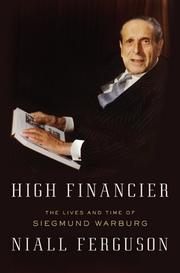
High Financier: The Lives and Time of Siegmund Warburg
Siegmund Warburg, who fled Germany and founded S.G. Warburg in London.
Summary
Ferguson had access to Siegmund Warburg's papers, including an enormous personal correspondence, and produced an authorised biography of the banker who founded S.G. Warburg in London after fleeing Germany, and who reshaped British merchant banking.
The business achievements are specific. Warburg ran the 1959 contested bid for British Aluminium, the first hostile takeover in Britain, which broke the cartel-like conventions of the City and made contested acquisitions possible. He created the eurobond market with the 1963 Autostrade issue, which established a market in dollar-denominated bonds outside American regulation and which became the foundation of international capital markets. He also built a firm on principles that contradicted City practice, hiring on merit including refugees and Jews when the established houses would not, and insisting on analytical depth rather than social connection.
The cultural material is substantial. Warburg's letters show a European intellectual who read constantly, distrusted Anglo-American commercial culture and thought bankers should be advisers with independent judgement rather than transaction processors. Ferguson uses him to argue that finance was better when it was relationship-based and long-horizon, which is the book's implicit thesis.
Ferguson is admiring and the book is long, and readers should note that a biography built on a subject's own voluminous self-documentation reflects how he wished to be understood. The claim that Warburg's model was superior to what replaced it is asserted through the narrative rather than demonstrated. The eurobond and British Aluminium chapters are the most useful to finance readers.
Key takeaways 7
- Warburg's 1959 British Aluminium bid was the first hostile takeover in Britain and broke the City convention that acquisitions were arranged among gentlemen.
- The 1963 Autostrade eurobond created a market in dollar securities outside American regulation, which became the foundation of international capital markets.
- Hiring on analytical merit rather than social connection was a competitive advantage in a City that recruited from a narrow class.
- Warburg regarded a bank's product as independent advice rather than transactions, and he declined business that conflicted with that position.
- Regulatory arbitrage created the eurobond market, since the demand existed because American rules made the domestic alternative unattractive.
- A merchant bank's capital was its reputation and its relationships rather than its balance sheet, which is what allowed a small firm to compete with large ones.
- Warburg's continental European formation gave him a view of British finance that the participants could not see from inside it.
Who should read it
Finance readers interested in the origin of hostile takeovers and the eurobond market, and in a model of banking based on advice rather than transaction volume.
About Niall Ferguson
Historian and senior fellow at the Hoover Institution, Stanford; previously taught at Oxford, Harvard and NYU Stern.
The Ascent of Money traces credit, bond markets, joint-stock equity, insurance and property finance from their origins, giving investors the institutional history behind instruments they price every day. The House of Rothschild and High Financier examine how two banking houses actually made money and managed sovereign and political risk over long periods.
Who recommended it 1 · 1 direct
Similar books 6
Chosen by shared topics, the entries that hold them, and the people who recommended both.
Life on Salomon Brothers' bond trading floor in the 1980s mortgage-bond boom.
“And then "Liar's Poker" from Michael Lewis, love that. I really like - I mythologize like Lewis Ranieri and all these guys when I read it.” — Chamath Palihapitiya
Source: Transcript: Chamath Palihapitiya
Recommended by: Chamath Palihapitiya, Michael Burry and 5 others
A trader's memoir of Wall Street's after-hours world of drugs, sex and commissions.
Recommended by: Mohnish Pabrai
The Rothschild banks of five cities from 1798 to 1999, from the family archive.
Recommended by: Mark Zuckerberg
An investment banker and ambassador on his life in finance and politics.
Recommended by: Mohnish Pabrai
Sandy Weill's rise from a back office to the merger that made Citigroup.
Recommended by: Mohnish Pabrai
KKR as an organisational innovation, and the governance case for the buyout.
“See George P. Baker and George David Smith, The New Financial Capitalists: Kohlberg Kravis Roberts and the Creation of Corporate Value (Cambridge, UK: Cambridge University Press, 1998), 207-208” — Michael Mauboussin
Source: Public to Private Equity in the United States: A Long-Term Look, page 58
Recommended by: Michael Mauboussin, Mohnish Pabrai
Where it sits in the reference 2
Topics 3
As an Amazon Associate I earn from qualifying purchases.