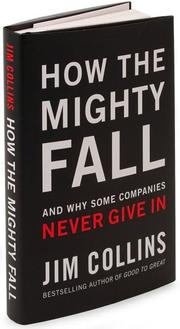
How the Mighty Fall
The stages by which great companies decline, and how to spot and reverse them early.
Summary
Collins examines company decline as a process with identifiable stages, written after the financial crisis and drawing on the same research base as his earlier books. His argument is that decline is detectable and reversible in its early stages and that the difficulty is that the early stages look like success.
He identifies five stages. Hubris born of success, in which the organisation stops asking why it succeeded and treats its position as deserved. Undisciplined pursuit of more, in which growth is pursued beyond what the organisation can staff or execute, frequently through acquisition into areas where it has no advantage. Denial of risk and peril, in which internal data shows deterioration and is explained away, external factors are blamed, and the leadership continues to project confidence. Grasping for salvation, in which the company seeks a single dramatic rescue, typically a charismatic outside chief executive, a transformational acquisition, an untested strategy or a cultural revolution. And capitulation to irrelevance or death.
His key practical claim is that the recovery move is the opposite of the intuition at stage four: companies that recovered did so through incremental disciplined action consistent with what they already understood, while companies that sought the dramatic rescue accelerated their decline.
The research method is the same as Good to Great, matching declining companies to comparison cases, and it carries the same criticism that the pattern is identified after the fact from a selected sample. The stage model is nonetheless usable as a diagnostic, and the warning about grasping for salvation is the most valuable part.
Key takeaways 7
- Company decline proceeds through five identifiable stages and is detectable and reversible in the early ones, which look like success from inside.
- The first stage is losing sight of why the company succeeded, which converts an understood advantage into an assumed entitlement.
- Growth pursued beyond what an organisation can staff and execute is the second stage, and it usually takes the form of acquisitions outside the core.
- Denial appears as explaining away internal data showing deterioration while attributing problems to external factors.
- Grasping for a single dramatic rescue, whether a charismatic outsider, a transformational acquisition or an untested strategy, accelerates decline rather than reversing it.
- Companies that recovered did so through incremental disciplined action consistent with what they already understood, which is the opposite of the intuition at that point.
- Decline is largely self-inflicted, and the point of no return comes later than most participants believe.
Who should read it
Executives and directors who want a diagnostic for organisational decline and a warning about the recovery moves that make it worse.
About Jim Collins
Management researcher; Stanford Graduate School of Business faculty 1988-1995, since then an independent researcher running a management laboratory in Boulder, Colorado
Built to Last and Good to Great are the primary research sources the enduring-company literature builds on and argues with.
Who recommended it 1
Similar books 6
Chosen by shared topics, the entries that hold them, and the people who recommended both.
What eleven companies did to turn fifteen ordinary years into fifteen great ones.
“(We invite you to read the chapter devoted to the company in the book “Good to Great”).” — Francois Rochon
Source: Giverny Capital Annual Letter to Partners 2006, page 7
Recommended by: Brian Armstrong, Francois Rochon and 20 others
What companies that beat their industries tenfold in turbulent times did differently.
Recommended by: Mohnish Pabrai, Tony Hsieh, Alfred Lin
Good to Great's principles applied to non-profits and the public sector.
Recommended by: Mohnish Pabrai
What eighteen long-lived companies did differently from close rivals in their fields.
“Drucker), Commander Watson noted that “people are driven by an intrinsic need to connect with a purpose larger than themselves,” and even quotes the authors of two best-selling business books: First hear Jim Collins, author of Built To Last: “The best executives aspire to create something bigger and more lasting than themselves—an on-going institution rooted in a set of timeless core values that exists for a purpose beyond …” — John C. Bogle
Source: Helping Others, page 4
Recommended by: John C. Bogle, Mohnish Pabrai, Drew Houston and 4 others
How the flywheel of reinforcing actions builds an organisation's momentum.
“If you are a CEO trying to build an enduring company, get Turning the Flywheel now and read it this upcoming weekend.” — Brad Feld
Source: Book: Turning the Flywheel — Feld Thoughts
Recommended by: Brad Feld
Why managers are rethinking the principles that have run their institutions.
Recommended by: Mohnish Pabrai
Where it sits in the reference 3
Topics 2
As an Amazon Associate I earn from qualifying purchases.