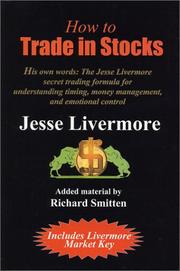
How to Trade in Stocks
A famous speculator's method of trading stocks by key price points and timing.
His only book; sets out pivotal points and time-element trading.
Summary
Jesse Livermore, one of the legendary traders of the first half of the twentieth century, set out his method of trading stocks in a book published in 1940. Time magazine called him the most fabulous living American stock trader. He rose from office boy to Wall Street legend, built and lost several fortunes, and, depending on the measure, his fortune peaked between $1.1 billion and $14 billion in today's money, all traded with his own money rather than other people's.
His reputation was so strong that even when he was deeply in debt banks would lend him money to start again, and he was known for always repaying his trading debts. The publisher says his trading rules earned him millions when he kept to them, and that he lost everything more than once when he ignored them. The techniques he made public have been used by stock and commodity traders for decades; the shelf's own note adds that the book sets out his key price points and the time element in trading.
Key takeaways 4
- Livermore's rules made him rich when he followed them and ruined him when he did not.
- He traded only his own money.
- Discipline in following one's rules matters more than any single trade.
- His methods have influenced traders for generations.
Who should read it
Traders and investors interested in the methods of a famous speculator.
About Jesse Livermore
Speculator, 1890s-1940; the trader behind Reminiscences of a Stock Operator
A legendary trading record and one late book of his own, though the canonical account of him was written by Lefevre.
Who recommended it 1 · 1 direct
“I stopped at the booth of a book dealer I know, and my eye immediately fell on a book he had for sale: How to Trade in Stocks, by Jesse Livermore.”
Similar books 6
Chosen by shared topics, the entries that hold them, and the people who recommended both.
A popular biography of Jesse Livermore, the stock speculator.
An early outside biography of the speculator Jesse Livermore.
The life of the trader Jesse Livermore, drawn from family sources.
A speculator modelled on Jesse Livermore learns to read and trade the market.
“For a long time, I used to read Reminiscences of a Stock Operator almost every year.” — Bill Miller
Source: Bill Miller 2Q 2020 Market Letter
Recommended by: Barton Biggs, Bill Miller, Colm O'Shea and 7 others
A biography of Jesse Livermore, the stock trader.
How financial innovation made markets more crisis-prone, from a risk manager.
“The New York Times of August 18 described A Demon of Our Own Design, by Richard Bookstaber (see “Investment Miscellany,” November 2000) as pointing out that “the proliferation of complex financial products like derivatives, combined with use of leverage to bolster returns, will inevitably mean that there will be a regular stream of market contagions like the one we’re having now – one of which, someday, could be calamitous.” 6” — Howard Marks
Source: Now It’s All Bad?, page 6
Recommended by: Howard Marks, Jeremy Grantham and 1 other
Where it sits in the reference 1
Topics 1
As an Amazon Associate I earn from qualifying purchases.