King of Capital: The Remarkable Rise, Fall, and Rise Again of Steve Schwarzman and Blackstone
Blackstone from its 1985 founding through its 2007 public offering and the crisis.
The standard firm history.
Summary
Carey and Morris, financial journalists, wrote the history of Blackstone with the firm's cooperation, covering Schwarzman and Peterson's founding in 1985 through the 2007 initial public offering and the crisis that followed.
The institutional history is the substance. They document the shift in private equity from the hostile leveraged buyouts of the 1980s, which were financed by junk bonds and depended on breaking up conglomerates, to the friendly negotiated deals of the 2000s financed by syndicated bank loans. They explain the fund structure, the two percent management fee and twenty percent carried interest, and the way management fee income on committed capital made the firms profitable independently of investment results, which is what made a public listing possible and what made the listing controversial.
They cover the specific deals in detail, including Equity Office Properties, the largest buyout ever completed, where Blackstone bought and immediately sold a majority of the properties, and Hilton, which was bought at the peak, written down heavily and eventually produced one of the largest gains in the industry's history.
The book also covers the diversification into real estate, credit and fund of funds that turned Blackstone into an asset manager rather than a buyout firm, which is the most consequential development for understanding the industry today.
Access journalism shapes the treatment. The authors are fair about the fee criticisms but the firm's own account of its judgement dominates. It ends in 2010 and predates the industry's growth to its current scale.
Key takeaways 7
- Private equity shifted from hostile junk-bond-financed takeovers in the 1980s to friendly negotiated deals financed by syndicated bank loans in the 2000s.
- Management fees charged on committed capital made buyout firms profitable independently of investment performance, which is what made public listings possible.
- The Equity Office Properties transaction worked because Blackstone had arranged the sale of a majority of the assets before completing the purchase.
- Deals bought at the peak of a credit cycle can still produce large returns if the sponsor can avoid a forced sale, as Hilton demonstrated.
- Diversifying into real estate, credit and fund products turned buyout firms into diversified asset managers, which changed their business from investing to gathering assets.
- Blackstone's advisory business, built from restructuring work, generated fee income that funded the firm before its investment business scaled.
- Access to committed long-duration capital is what allows a private equity sponsor to hold through a downturn, which is the structural advantage over public market investors.
Who should read it
Investors and operators who want the institutional history of how buyout firms became diversified asset managers and how their economics actually work.
Who recommended it 3 · 3 direct
“Carey, David and John E. Morris, King of Capital: The Remarkable Rise, Fall, and Rise Again of Steve Schwartzman and Blackstone (New York: Currency, 2010)”
Similar books 6
Chosen by shared topics, the entries that hold them, and the people who recommended both.
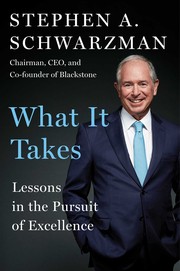
Blackstone's co-founder on his career and on building the firm.
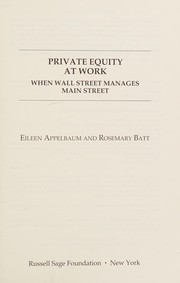
What private equity does to companies, workers and investor returns, critically.
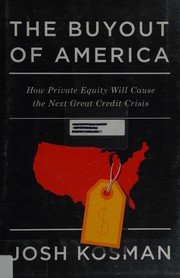
The case that leveraged buyouts harm companies and would cause a credit crisis.
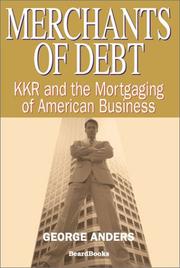
KKR from 1976 through the RJR Nabisco buyout, and what debt did to its companies.
“Anders, George, Merchants of Debt: KKR and the Mortgaging of American Business (New York: Basic Books, 1992)” — Michael Mauboussin
Source: Public to Private Equity in the United States: A Long-Term Look, page 67
Recommended by: Michael Mauboussin
The 1988 bidding war for RJR Nabisco, the largest leveraged buyout to that date.
“Bryan Burroughs and John Helyar, Barbarians at the Gate: The Fall of RJR Nabisco (New York: Harper & Row, 1990), 133-138 and George Anders, Merchants o” — Michael Mauboussin
Source: Public to Private Equity in the United States: A Long-Term Look, page 62
Recommended by: Jim Collins, Michael Mauboussin and 2 others

How bankers value companies, model buyouts and run mergers and acquisitions.
“Joshua Rosenbaum and Joshua Pearl, Investment Banking: Valuation, Leveraged Buyouts, and Mergers and Acquisitions, Second Edition (Hoboken, NJ: John Wiley & Sons, 2013) and Sanjeev Bhojraj, Charles M” — Michael Mauboussin
Source: How Well Do You Compare?, page 15
Recommended by: Michael Mauboussin, Mohnish Pabrai