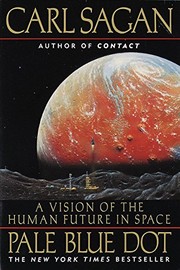
Pale Blue Dot: A Vision of the Human Future in Space
Earth as seen in Voyager 1's distant photograph, and the human future in space.
Summary
Carl Sagan's 1994 sequel to Cosmos takes its name from the photograph of Earth that Voyager 1 took on 14 February 1990 from more than 6 billion kilometres away, in which the planet is less than a pixel; NASA took it after Sagan's advocacy. The book mixes philosophy about humanity's place in the universe with an account of what was known of the Solar System, and a vision of the human future in space.
Sagan first examines the long-held claims that Earth and humans are unique, and suggests the geocentric idea lasted through human pride and the threat of torture for dissenters, as under the Roman Inquisition. He then tours the Solar System, starting with the Voyager programme on which he worked, its low light levels and the faults of the ageing craft, and asks of each planet and of moons such as Titan, Triton and Miranda whether life is possible there. He calls NASA's retreat from the Moon after Apollo short-sighted, uses the 1994 impact of comet Shoemaker-Levy 9 on Jupiter to warn of asteroid and comet strikes, and argues that settling other worlds and terraforming are conditions for humanity's survival.
Key takeaways 5
- The Pale Blue Dot photograph shows Earth as a speck from 6 billion kilometres away.
- Studying other planets gives context for protecting Earth.
- Sagan calls the cut in lunar exploration after Apollo short-sighted.
- Tracking large asteroids and comets is needed to protect the planet.
- Sagan argues that settling other worlds is necessary for long-term survival.
Who should read it
Readers who want Sagan's case for space exploration and a humbler view of humanity's place.
Who recommended it 2
Similar books 6
Chosen by shared topics, the entries that hold them, and the people who recommended both.
How science and civilisation grew up together, and the long journey of discovery.
Recommended by: Richard Branson, Maria Popova
Answers to the Fermi paradox: why we have found no aliens.
Recommended by: Patrick Collison, Elon Musk

The engineering design of liquid-propellant rocket engines, with 470 illustrations.
Recommended by: Elon Musk
Why structures hold up or fail: tension, compression, shear and fracture explained.
Recommended by: Elon Musk, Marc Andreessen
From the origin of the universe through life and consciousness to what it all means.
Recommended by: Elon Musk, Scott Farquhar