Updates

  1. Person pages list letters, writing, profiles and links as sortable tables with filters, and show each person's companies as links; Fund letters show each letter's description in its own column.
  2. Experts show a checked job title and a short description of each person; 30 more people have photographs.
  3. Every company, fund, university and publication the experts work for has a page listing the people there.
  4. Fund letters show each letter's thesis and filter by it; 225 person pages list the essays, columns and newsletter issues the person wrote.
  5. Person pages list every essay and newsletter issue a person wrote, and their own books as a table in List view.
  6. Recommends shows the five largest kinds of book and the rest under More; browse pictures load sooner.
  7. Podcasts and talks link the original episode, filter by Audio and video or Press, and list each publisher once.
  8. Pages are wider, Recommends has List and Grid, and a filter clicked again turns off.
  9. Book cards sit in a ruled grid with Open Library and Goodreads links and each book's one-line note.
  10. Funds is now Investors; each investor's styles are buttons that filter the table.
  11. Podcasts and talks on a person's page filter by year and publisher and show as a list or a grid of pictures.
  12. Quotes show only people's own words: 472 summaries written by list sites are gone.
  13. Country pages open from Browse again, and every link on the shelf lands on a page.
  14. Subject and person pages show their sections as tabs, and each book appears once on a person's page.
  15. Book cards show the quote, who said it and the source; grids show five cards to a row.
  16. On a phone, a menu holds the sections, search, Updates, Feedback and dark mode.
  17. Feedback takes a screenshot of the page with no browser prompt, opens a screenshot full size when you click it, and clears itself once sent.
  18. Book cards are centred, search names the topic each book sits in, and any text cut short shows whole on hover.
  19. Search groups its results by kind: people, companies, geographies, subjects, topics, books, funds, fund letters and papers.
  20. The Books table lists who recommended each book by name, and the browser tab names the section you are in.
  21. Feedback can take a screenshot of the page, or one you paste or choose, and opens in the corner beside Updates.
  22. Each rail button reopens its section where you left it, and Browse, Table and People show on every book and subject page.
  23. Filters grey out choices that hold nothing instead of hiding them, and Books › People filters by authors or recommenders.
  24. Feedback takes a subject line and up to three screenshots.
  25. Biographies are grouped by the person they are about: 41 new pages, from Abraham Lincoln to Lee Kuan Yew.
  26. Sport splits into 23 sports, and Religion into one topic per faith.
  27. Book lists show as cards: the cover, one recommendation quote and every recommender by name.
  28. Seventeen subjects that had two or three pages under different names now have one page each.
  29. Every page lists its Experts as authors and recommenders, with a link to them on the Experts tab.
  30. Economics, Financial history, Financial panics and Accounting are subjects of their own, with one page per financial crisis.
  31. Book, person and subject pages open inside the app, so the tabs stay in view.
  32. 996 more book covers, and photographs or logos for 227 more people and companies.
  33. Books › Browse shows every subject as cards, and the rail holds Fund letters, Papers, Experts, Books and Funds.
  34. Every topic over 150 books splits into narrower topics, each with a page of its own.

Send feedback

What is it?
Screenshots, up to 3 (optional)
or paste one with Ctrl+V

We use your email only to reply to you.

Real Estate Investment Trusts

Real Estate Investment Trusts

Su Han Chan, John Erickson, Ko Wang
2002
T3 268 pages · about 4h 28m to read Open Librarygoodreads

Academic survey of REIT structure and performance.

Summary

Su Han Chan, John Erickson and Ko Wang wrote this as a survey of the academic research on real estate investment trusts, aimed at readers who want to know what the empirical literature establishes rather than what practitioners claim.

The questions they cover are the ones the research has addressed: whether REIT returns behave like equities or like direct property, and the finding that they correlate more with small-cap equities in the short run and with property over longer horizons; whether REITs provide diversification benefit in a mixed-asset portfolio; how REIT management structures, particularly the shift from external advisers to internal management after 1986, affected performance and conflicts of interest; whether REITs are efficiently priced, including the persistent discounts and premiums to net asset value; the effect of leverage; the determinants of REIT dividend policy given the distribution requirement; and the performance of REIT initial public offerings.

The book is a literature survey and reports findings with their qualifications rather than reaching confident conclusions. It was published in 2002, before the substantial growth of the sector, before REITs entered the major equity indices, and before the 2008 crisis tested their leverage and refinancing. The methodological framing remains useful for anyone evaluating current claims about the asset class.

Key takeaways 7

  1. REIT returns correlate with small-capitalisation equities over short horizons and with direct property over longer ones.
  2. The shift from external advisers to internal management after 1986 reduced conflicts of interest and improved measured performance.
  3. REITs trade at persistent discounts and premiums to net asset value, which is difficult to reconcile with efficient pricing.
  4. The distribution requirement forces REITs to raise external capital for growth, which subjects them to market discipline more frequently than other firms.
  5. Diversification benefit from adding REITs to a mixed-asset portfolio is smaller than the direct property literature implies.
  6. REIT initial public offerings show the underperformance pattern found in other equity offerings.
  7. Leverage explains a substantial share of the return differences between REITs, which means comparing them without adjusting for it is uninformative.

Who should read it

Investors and analysts evaluating listed property exposure who want the empirical research findings rather than industry marketing.

Similar books 6

Chosen by shared topics, the entries that hold them, and the people who recommended both.
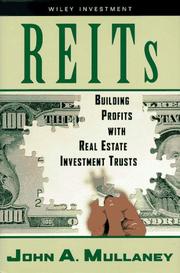
John A. Mullaney · 1997

Early practitioner introduction to the vehicle.

Stephanie Krewson-Kelly, Glenn R. Mueller · 2020

How to value REITs and read the property cycles that move them.

Andrew Baum, David Hartzell · 2011

How property is priced across borders, and owning it directly versus listed.

Ralph L. Block · 1998

A guide to real estate investment trusts as an asset class for investors.

Stephanie Krewson-Kelly, R. Brad Thomas · 2016

Sector-by-sector guide to REIT metrics and FFO analysis.

Sam Zell · 2017

From student apartments in Ann Arbor to selling Equity Office to Blackstone in 2007.

Recommended by: Codie Sanchez

Where it sits in the reference 1

Assets

Topics

InvestingFinance and Markets