Updates

  1. Person pages list letters, writing, profiles and links as sortable tables with filters, and show each person's companies as links; Fund letters show each letter's description in its own column.
  2. Experts show a checked job title and a short description of each person; 30 more people have photographs.
  3. Every company, fund, university and publication the experts work for has a page listing the people there.
  4. Fund letters show each letter's thesis and filter by it; 225 person pages list the essays, columns and newsletter issues the person wrote.
  5. Person pages list every essay and newsletter issue a person wrote, and their own books as a table in List view.
  6. Recommends shows the five largest kinds of book and the rest under More; browse pictures load sooner.
  7. Podcasts and talks link the original episode, filter by Audio and video or Press, and list each publisher once.
  8. Pages are wider, Recommends has List and Grid, and a filter clicked again turns off.
  9. Book cards sit in a ruled grid with Open Library and Goodreads links and each book's one-line note.
  10. Funds is now Investors; each investor's styles are buttons that filter the table.
  11. Podcasts and talks on a person's page filter by year and publisher and show as a list or a grid of pictures.
  12. Quotes show only people's own words: 472 summaries written by list sites are gone.
  13. Country pages open from Browse again, and every link on the shelf lands on a page.
  14. Subject and person pages show their sections as tabs, and each book appears once on a person's page.
  15. Book cards show the quote, who said it and the source; grids show five cards to a row.
  16. On a phone, a menu holds the sections, search, Updates, Feedback and dark mode.
  17. Feedback takes a screenshot of the page with no browser prompt, opens a screenshot full size when you click it, and clears itself once sent.
  18. Book cards are centred, search names the topic each book sits in, and any text cut short shows whole on hover.
  19. Search groups its results by kind: people, companies, geographies, subjects, topics, books, funds, fund letters and papers.
  20. The Books table lists who recommended each book by name, and the browser tab names the section you are in.
  21. Feedback can take a screenshot of the page, or one you paste or choose, and opens in the corner beside Updates.
  22. Each rail button reopens its section where you left it, and Browse, Table and People show on every book and subject page.
  23. Filters grey out choices that hold nothing instead of hiding them, and Books › People filters by authors or recommenders.
  24. Feedback takes a subject line and up to three screenshots.
  25. Biographies are grouped by the person they are about: 41 new pages, from Abraham Lincoln to Lee Kuan Yew.
  26. Sport splits into 23 sports, and Religion into one topic per faith.
  27. Book lists show as cards: the cover, one recommendation quote and every recommender by name.
  28. Seventeen subjects that had two or three pages under different names now have one page each.
  29. Every page lists its Experts as authors and recommenders, with a link to them on the Experts tab.
  30. Economics, Financial history, Financial panics and Accounting are subjects of their own, with one page per financial crisis.
  31. Book, person and subject pages open inside the app, so the tabs stay in view.
  32. 996 more book covers, and photographs or logos for 227 more people and companies.
  33. Books › Browse shows every subject as cards, and the rail holds Fund letters, Papers, Experts, Books and Funds.
  34. Every topic over 150 books splits into narrower topics, each with a page of its own.

Send feedback

What is it?
Screenshots, up to 3 (optional)
or paste one with Ctrl+V

We use your email only to reply to you.

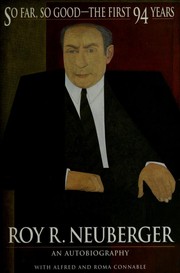
So Far, So Good: The First 94 Years

So Far, So Good: The First 94 Years

Roy R. Neuberger
1997
T3 239 pages · about 3h 59m to read Open Librarygoodreads

Memoir of a hedged-equity pioneer's seven decades on Wall Street

Summary

Neuberger founded Neuberger Berman in 1939 and worked on Wall Street for almost seven decades, having started at Halle and Stieglitz in 1929 shortly before the crash. This memoir, written at ninety-four, covers his career, his investment approach and his art collecting.

The investment content centres on hedging. Neuberger paired long and short positions from early in his career, and he describes shorting Radio Corporation of America in 1929 against his long positions as the trade that preserved his capital through the crash. He is a trader rather than a buy-and-hold investor, and his stated approach emphasises attention to price, willingness to take small losses quickly, and scepticism about holding a position because of an attachment to the company. He also discusses the mutual fund business he built and the shift in the industry over his lifetime.

The art collecting is a substantial part of the book. Neuberger bought contemporary American work by living artists, including Pollock, de Kooning, Rothko and Avery, on a policy of never selling and of donating to public institutions, and he founded the Neuberger Museum at Purchase College.

The book is a memoir rather than a manual, with anecdote rather than method, and readers looking for a systematic investment framework will not find one. The reference has not verified many of the specific claims about individual trades, which rest on the author's recollection decades later. Its value is as a first-hand account of Wall Street across an unusually long span and as an early statement of long-short practice.

Key takeaways 7

  1. Holding short positions against a long book preserved capital through the 1929 crash and became the basis of Neuberger's approach for the rest of his career.
  2. Taking small losses quickly is the discipline that separates traders who survive from those who do not.
  3. Attachment to a company as an institution is a source of investment error, and a position should be judged on price and prospects alone.
  4. An investor should pay attention to what the market is doing rather than insisting the market recognise a valuation.
  5. Buying art from living artists at low prices and never selling produced both a collection and a public institution, and Neuberger treated the no-sale rule as essential to the approach.
  6. A long career in markets is survived by avoiding ruin rather than by maximising any individual result.
  7. Investment management as a business changed from a craft practised by partners to an asset-gathering industry over the course of his career.

Who should read it

Investors interested in a first-hand account of long-short practice and Wall Street across seven decades, read as memoir rather than method.

Who recommended it 2 · 2 direct

“I sometimes reread older books like 'So Far, So Good - the First 94 Years,' written by Roy Neuberger in 1997. It always fascinates me how things are basically the same on Wall Street. Sound…”

“Roy never fails to amuse and enlighten. Over the years, he's taught me many things I didn't know I didn't know.”

Similar books 6

Chosen by shared topics, the entries that hold them, and the people who recommended both.
Daniel A. Strachman · 2004

Tiger Management, the firm that set the long-short template.

Recommended by: Mohnish Pabrai
Maneet Ahuja · 2012

Profiles of the hedge fund managers who ran their strategies at scale after 2008.
Lois Peltz · 2001

Profiles of the hedge fund managers who rose above thousands of others in a decade.

Recommended by: Mohnish Pabrai

Where it sits in the reference 2

Business themes
Investment styles

Topics

Biography and MemoirInvestingInvestors, Traders and GamblersMutual fund and bond managers