Updates

  1. Person pages list letters, writing, profiles and links as sortable tables with filters, and show each person's companies as links; Fund letters show each letter's description in its own column.
  2. Experts show a checked job title and a short description of each person; 30 more people have photographs.
  3. Every company, fund, university and publication the experts work for has a page listing the people there.
  4. Fund letters show each letter's thesis and filter by it; 225 person pages list the essays, columns and newsletter issues the person wrote.
  5. Person pages list every essay and newsletter issue a person wrote, and their own books as a table in List view.
  6. Recommends shows the five largest kinds of book and the rest under More; browse pictures load sooner.
  7. Podcasts and talks link the original episode, filter by Audio and video or Press, and list each publisher once.
  8. Pages are wider, Recommends has List and Grid, and a filter clicked again turns off.
  9. Book cards sit in a ruled grid with Open Library and Goodreads links and each book's one-line note.
  10. Funds is now Investors; each investor's styles are buttons that filter the table.
  11. Podcasts and talks on a person's page filter by year and publisher and show as a list or a grid of pictures.
  12. Quotes show only people's own words: 472 summaries written by list sites are gone.
  13. Country pages open from Browse again, and every link on the shelf lands on a page.
  14. Subject and person pages show their sections as tabs, and each book appears once on a person's page.
  15. Book cards show the quote, who said it and the source; grids show five cards to a row.
  16. On a phone, a menu holds the sections, search, Updates, Feedback and dark mode.
  17. Feedback takes a screenshot of the page with no browser prompt, opens a screenshot full size when you click it, and clears itself once sent.
  18. Book cards are centred, search names the topic each book sits in, and any text cut short shows whole on hover.
  19. Search groups its results by kind: people, companies, geographies, subjects, topics, books, funds, fund letters and papers.
  20. The Books table lists who recommended each book by name, and the browser tab names the section you are in.
  21. Feedback can take a screenshot of the page, or one you paste or choose, and opens in the corner beside Updates.
  22. Each rail button reopens its section where you left it, and Browse, Table and People show on every book and subject page.
  23. Filters grey out choices that hold nothing instead of hiding them, and Books › People filters by authors or recommenders.
  24. Feedback takes a subject line and up to three screenshots.
  25. Biographies are grouped by the person they are about: 41 new pages, from Abraham Lincoln to Lee Kuan Yew.
  26. Sport splits into 23 sports, and Religion into one topic per faith.
  27. Book lists show as cards: the cover, one recommendation quote and every recommender by name.
  28. Seventeen subjects that had two or three pages under different names now have one page each.
  29. Every page lists its Experts as authors and recommenders, with a link to them on the Experts tab.
  30. Economics, Financial history, Financial panics and Accounting are subjects of their own, with one page per financial crisis.
  31. Book, person and subject pages open inside the app, so the tabs stay in view.
  32. 996 more book covers, and photographs or logos for 227 more people and companies.
  33. Books › Browse shows every subject as cards, and the rail holds Fund letters, Papers, Experts, Books and Funds.
  34. Every topic over 150 books splits into narrower topics, each with a page of its own.

Send feedback

What is it?
Screenshots, up to 3 (optional)
or paste one with Ctrl+V

We use your email only to reply to you.

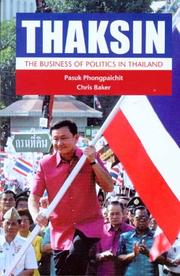
Thaksin

Thaksin

Pasuk Phongpaichit, Chris Baker
2004
T3 302 pages · about 5h 2m to read Open Librarygoodreads

Telecoms billionaire turned prime minister; the clearest study of business-politics fusion in Thailand.

Summary

Phongpaichit and Baker wrote a political and business biography of Thaksin Shinawatra, covering his rise from police officer to telecommunications magnate to prime minister.

The business sections are the most useful for investors. The authors trace how Thaksin built Shin Corporation on state concessions: pager services, mobile telephony through the AIS concession, satellite operations through Shinawatra Satellite, and cable television. Each business depended on a licence or concession granted by the state, and the authors argue that the ability to obtain and to renegotiate these was the actual competitive asset. They document the terms and the subsequent amendments, and connect the company's value to political access.

The political sections cover the founding of Thai Rak Thai, the 2001 election, and the policy programme: universal healthcare at low cost, village funds providing credit outside the banking system, debt relief for farmers, and support for small enterprise. The authors argue that Thaksin was the first Thai politician to build a genuine mass electoral base by delivering material benefits to rural voters, and that this is why the Bangkok establishment opposed him. They also document the war on drugs with its extrajudicial killings, the handling of the southern insurgency, the pressure on media, and the concentration of business and political power in one person.

The book was published in 2004, before the 2006 coup, and was revised in later editions.

The authors write critically of both Thaksin and the establishment that removed him, which makes it more useful than the partisan accounts on either side. It is specific about business structures in a way that political biographies usually are not.

Key takeaways 7

  1. Shin Corporation was built on state telecommunications concessions, so political access rather than operational capability was the competitive asset.
  2. Concession terms were renegotiated during Thaksin's political career in ways that benefited his companies.
  3. Thaksin was the first Thai politician to win a parliamentary majority by delivering material benefits to rural voters.
  4. Universal healthcare and village credit funds created a durable electoral base that Bangkok-based parties could not match.
  5. Concentrating business ownership and executive political power in one person produced conflicts that the constitution did not anticipate.
  6. The Bangkok establishment's opposition was driven by the loss of political control rather than by the corruption allegations alone.
  7. Business empires built on state concessions are vulnerable to political change in exactly the way that ordinary operating businesses are not.

Who should read it

Investors and operators in Thailand and comparable markets who need to understand how concession-based businesses and political power interact.

About Pasuk Phongpaichit

Emeritus professor of economics at Chulalongkorn University in Bangkok; writes on Thailand's economy, politics, corruption and inequality.

The Thailand books track one economy through a credit-fuelled boom, the 1997 devaluation and the political conflict that followed, measuring the informal economy and the business-political networks instead of assuming them away. Anyone underwriting Southeast Asian exposure finds here the local mechanics linking capital, patronage and policy.

Chulalongkorn University

Similar books 6

Chosen by shared topics, the entries that hold them, and the people who recommended both.
Pasuk Phongpaichit, Chris Baker · 1995

The pre-crisis baseline: how the boom economy was actually structured.
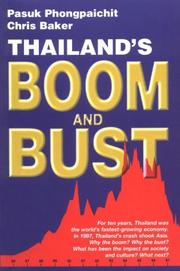
Pasuk Phongpaichit, Chris Baker · 1998

The definitive account of the bubble and the baht devaluation that started the Asian crisis.
Pasuk Phongpaichit, Chris Baker · 2000

Follow-up on the IMF programme, bank restructuring and who paid for it.

Pasuk Phongpaichit, Chris Baker · 2016

Concentration of wealth, land and market power among a few families.

Chris Baker, Pasuk Phongpaichit · 2005

The standard modern history, strong on business families and state capital.
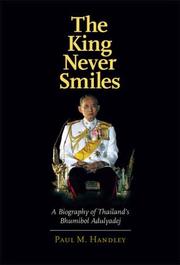
Paul M. Handley · 2006

The monarchy and the Crown Property Bureau as an economic institution.

Where it sits in the reference 3

Academics
Journalists
Geographies

Topics

Biography and MemoirPolitics and GovernmentPolitical Leaders and PolicymakersAsia and the PacificLeaders of Asia and the Pacific