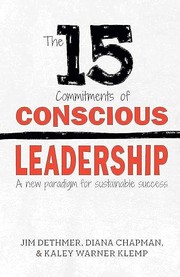
The 15 Commitments of Conscious Leadership
Fifteen commitments for leading from curiosity instead of defensiveness.
Summary
Dethmer, Chapman and Klemp present fifteen paired commitments, each contrasting what they call above the line behaviour, meaning open, curious and committed to learning, with below the line behaviour, meaning closed, defensive and committed to being right. Their first instruction is to notice which side of the line you are on, on the argument that locating yourself matters more than being above it.
The commitments include taking radical responsibility rather than assigning blame; learning through curiosity rather than defending a position; feeling all feelings through to completion rather than suppressing them; speaking candidly, which they define as revealing rather than concealing; eliminating gossip, defined as speaking about someone in a way you would not speak to them; practising integrity as the alignment of what you think, feel, say and do; generating appreciation; excelling in your zone of genius; living a life of play and rest; exploring the opposite of any position you hold; sourcing approval, control and security from yourself; having enough of everything; experiencing the world as an ally; creating win-for-all solutions; and being the resolution rather than waiting for it.
The framework draws on Hendricks' work on the zone of genius, on somatic psychology and on the drama triangle of victim, villain and hero, which they use to describe how organisations reproduce conflict.
The book has no evidence base and is entirely the authors' coaching practice. The language is therapeutic and many business readers reject it on that basis. The drama triangle and the above and below the line distinction are the two elements that transfer most readily into ordinary management conversation, and they can be adopted without the rest of the framework.
Key takeaways 8
- Any moment can be located above or below a line, meaning open and curious or defensive and committed to being right, and noticing which matters more than which it is.
- Radical responsibility means locating the cause of an outcome in yourself rather than assigning blame, including blame directed at yourself.
- Organisations reproduce conflict through a triangle of victim, villain and hero, and everyone rotates through all three positions.
- Gossip is defined as speaking about someone in a way you would not speak to them, and it is the primary mechanism by which trust degrades.
- Integrity means alignment between what a person thinks, feels, says and does, and any gap between them consumes energy continuously.
- Candour means revealing what you are withholding rather than delivering criticism, which is a different act from giving feedback.
- Operating in a zone of genius, meaning work that is both uniquely suited to you and energising, is treated as an obligation rather than a luxury.
- Suppressed emotion persists and drives behaviour indirectly, which is why the authors treat feeling emotions through as a leadership practice.
Who should read it
Founders and executive teams working on how they relate to each other, prepared for a therapeutic register and no evidence base.
Who recommended it 6
Similar books 6
Chosen by shared topics, the entries that hold them, and the people who recommended both.
How self-deception undermines leaders, told as a story set at a company.
Recommended by: Mohnish Pabrai, Girish Mathrubootham and 2 others
Gallup's research on how leaders use their strengths and those of their teams.
Recommended by: Brian Armstrong
A short guide to everyday leadership, revised for the modern workplace.
Recommended by: Tim Ferriss, Ali Abdaal, Brian Armstrong
Five levels of leadership, from holding a position to developing other people.
Recommended by: Julie Stevanja
Gandhi's life and principles restated as a standard for executives.
Recommended by: Mohnish Pabrai