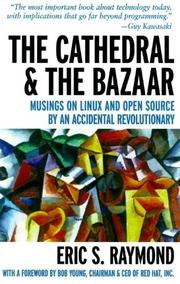
The Cathedral and the Bazaar
Essays on open-source software and its model of collaborative development.
The essay collection that made the commercial case for open development.
Summary
Raymond's title essay, first presented at the Linux Kongress in Würzburg on 27 May 1997 and published as the second chapter of the 1999 book, contrasts two models of free software development. In the cathedral model, used for GNU Emacs and GCC, source code is released with each version but the work between releases is restricted to a small group of developers. In the bazaar model, which Raymond credits to Linus Torvalds and the Linux kernel, code is developed over the internet in public view.
The central thesis is Linus's law: given enough eyeballs, all bugs are shallow. The more widely source code is open to testing and scrutiny, the faster its bugs are found, while cathedral projects spend heavy time hunting bugs that only a few people can see. Raymond draws on the Linux kernel's development and on his own experience running the fetchmail project. The book's publisher pitched the collection at business readers, citing a Forrester finding that 56 percent of IT managers at Global 2,500 companies already used open-source software.
Key takeaways 4
- Software can be developed by a closed group between releases, the cathedral, or in public over the internet, the bazaar.
- Given enough eyeballs, all bugs are shallow: wide access to source code finds defects faster.
- Restricting working code to a few developers makes bug-hunting slow and costly.
- By the late 1990s large companies were already running open-source software in their infrastructure.
Who should read it
Executives, engineers and investors who want the founding argument for open-source development and why companies came to adopt it.
Who recommended it 2
Similar books 6
Chosen by shared topics, the entries that hold them, and the people who recommended both.
Richard Stallman, the free software movement and the GPL licence he wrote.
How Linux came to be developed, and how its creator thinks.
How to run an open source project, its community and its sponsors.
The history of Linux, open-source software and the businesses built around it.
How open-source software gets made without conventional property rights.

How open-source software is really made and maintained, often by a few people.
Recommended by: Balaji S. Srinivasan, Delian Asparouhov