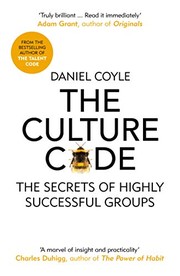
The Culture Code
Three skills strong groups share: building safety, sharing vulnerability, purpose.
Coyle examines high-performing groups — SEAL teams, Pixar, the San Antonio Spurs — to identify the three skills that build strong cultures: building safety, sharing vulnerability, and establishing purpose. The research is descriptive rather than prescriptive, which makes it more credible than most culture books.
Summary
Coyle studied groups with unusually strong performance, including a Navy SEAL team, IDEO, Pixar, the San Antonio Spurs, a jewel thief crew and a comedy improvisation troupe, and identifies three skills that produce group cohesion: building safety, sharing vulnerability and establishing purpose.
The safety section draws on research showing that belonging cues, which are small signals of attention, proximity and future connection, drive group performance more than any individual capability. He reports the finding from the MIT Human Dynamics Laboratory that patterns of interaction predicted team performance better than the content of what was said. He documents specific practices including how Gregg Popovich delivers criticism paired with signals of belonging, and how leaders in these groups over-communicate their appreciation.
The vulnerability section argues that cooperation follows from a signal of vulnerability rather than preceding it, using research on the vulnerability loop, in which one person's admission of a limitation invites a reciprocal admission and cooperation follows. He documents after-action reviews at SEAL teams and the Braintrust at Pixar as institutionalised forms.
The purpose section argues that groups convey purpose through repeated small signals and through explicit priorities rather than through statements, and that high-performing groups repeat their priorities to a degree that outsiders find excessive. Each section ends with concrete practices. The evidence is a mixture of research and selected cases, and several cited studies have replicated weakly. Coyle chose successful groups and identified what they share, which cannot show whether failed groups share it too. The specific practices are usable regardless.
Key takeaways 8
- Group performance depends on belonging cues, meaning small repeated signals of attention, proximity and expected future connection.
- Patterns of interaction within a team predict its performance better than the content of what members say or their individual capability.
- Cooperation follows a signal of vulnerability rather than preceding it, so a leader admitting a limitation is what starts the process.
- Leaders in high-performing groups signal their own fallibility explicitly and repeatedly, which invites the disagreement they need.
- Criticism is accepted when paired with an explicit signal that the person belongs and that the standard is high because of confidence in them.
- High-performing groups repeat their priorities far more often than outsiders consider necessary, and the repetition is what makes the priority operative.
- After-action reviews work only when the most senior person speaks last and admits their own errors first.
- Physical proximity and small design choices about space measurably change interaction frequency and therefore group performance.
Who should read it
Leaders trying to build team cohesion who want specific practices rather than statements about culture, treating the research base as mixed.
Who recommended it 5 · 1 direct
“We can go into it if it's of interest. Culture Code by Daniel Coyle I give people.”
Similar books 6
Chosen by shared topics, the entries that hold them, and the people who recommended both.
Organisational health, clarity and cohesion, matters more than strategy or smarts.
Recommended by: Changpeng Zhao, David Cancel
How Google hires, manages and pays its people, with the data behind each choice.
Recommended by: Mohnish Pabrai, Changpeng Zhao, David Cancel and 3 others
Decision rules from building Bridgewater: radical truth and radical transparency.
“Several people recommended Ray Dalio’s book Principles to me.” — Brad Feld
Source: Book: Principles by Ray Dalio — Feld Thoughts
Recommended by: Alfred Lin, Brad Feld, Derek Sivers and 31 others
Leaderless organisations, from Alcoholics Anonymous to file sharing, and their power.
Recommended by: Mohnish Pabrai, Changpeng Zhao, Simon Sinek
How to rate an organisation's tribal culture on five stages and raise it.
“Tribal Leadership by Dave Logan. Dave Logan has looked at thousands of organizations and puts them into categories.” — Graham Duncan
Source: The Tim Ferriss Show Transcripts: Graham Duncan (#362)
Recommended by: Graham Duncan, Tony Hsieh, Sahil Lavingia
Ideas for empowering employees: self-directed teams, initiative and risk.
Recommended by: Mohnish Pabrai