Updates

  1. Person pages list letters, writing, profiles and links as sortable tables with filters, and show each person's companies as links; Fund letters show each letter's description in its own column.
  2. Experts show a checked job title and a short description of each person; 30 more people have photographs.
  3. Every company, fund, university and publication the experts work for has a page listing the people there.
  4. Fund letters show each letter's thesis and filter by it; 225 person pages list the essays, columns and newsletter issues the person wrote.
  5. Person pages list every essay and newsletter issue a person wrote, and their own books as a table in List view.
  6. Recommends shows the five largest kinds of book and the rest under More; browse pictures load sooner.
  7. Podcasts and talks link the original episode, filter by Audio and video or Press, and list each publisher once.
  8. Pages are wider, Recommends has List and Grid, and a filter clicked again turns off.
  9. Book cards sit in a ruled grid with Open Library and Goodreads links and each book's one-line note.
  10. Funds is now Investors; each investor's styles are buttons that filter the table.
  11. Podcasts and talks on a person's page filter by year and publisher and show as a list or a grid of pictures.
  12. Quotes show only people's own words: 472 summaries written by list sites are gone.
  13. Country pages open from Browse again, and every link on the shelf lands on a page.
  14. Subject and person pages show their sections as tabs, and each book appears once on a person's page.
  15. Book cards show the quote, who said it and the source; grids show five cards to a row.
  16. On a phone, a menu holds the sections, search, Updates, Feedback and dark mode.
  17. Feedback takes a screenshot of the page with no browser prompt, opens a screenshot full size when you click it, and clears itself once sent.
  18. Book cards are centred, search names the topic each book sits in, and any text cut short shows whole on hover.
  19. Search groups its results by kind: people, companies, geographies, subjects, topics, books, funds, fund letters and papers.
  20. The Books table lists who recommended each book by name, and the browser tab names the section you are in.
  21. Feedback can take a screenshot of the page, or one you paste or choose, and opens in the corner beside Updates.
  22. Each rail button reopens its section where you left it, and Browse, Table and People show on every book and subject page.
  23. Filters grey out choices that hold nothing instead of hiding them, and Books › People filters by authors or recommenders.
  24. Feedback takes a subject line and up to three screenshots.
  25. Biographies are grouped by the person they are about: 41 new pages, from Abraham Lincoln to Lee Kuan Yew.
  26. Sport splits into 23 sports, and Religion into one topic per faith.
  27. Book lists show as cards: the cover, one recommendation quote and every recommender by name.
  28. Seventeen subjects that had two or three pages under different names now have one page each.
  29. Every page lists its Experts as authors and recommenders, with a link to them on the Experts tab.
  30. Economics, Financial history, Financial panics and Accounting are subjects of their own, with one page per financial crisis.
  31. Book, person and subject pages open inside the app, so the tabs stay in view.
  32. 996 more book covers, and photographs or logos for 227 more people and companies.
  33. Books › Browse shows every subject as cards, and the rail holds Fund letters, Papers, Experts, Books and Funds.
  34. Every topic over 150 books splits into narrower topics, each with a page of its own.

Send feedback

What is it?
Screenshots, up to 3 (optional)
or paste one with Ctrl+V

We use your email only to reply to you.

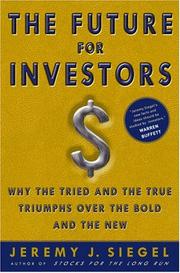
The Future for Investors

The Future for Investors

Jeremy Siegel
2005
T4 327 pages · about 5h 27m to read Open Librarygoodreads

Dividend reinvestment as the bear market protector and return accelerator.

Summary

Siegel argues that investors systematically overpay for growth and that the highest long-run returns have come from established companies in mature or declining industries that were priced low and paid dividends which were reinvested.

His central evidence is a study of the original 1957 Standard and Poor's 500 constituents held to 2003. He finds the best performer over that period was Philip Morris, a company in a shrinking, litigated, heavily taxed industry, and that the portfolio of original constituents held without change outperformed the continuously updated index. His explanation is what he calls the growth trap: investors bid up companies and sectors with visible growth prospects to prices that impound more growth than is delivered, while ignored companies with low expectations deliver returns above their price implies. Dividend reinvestment is the mechanism, since a low-priced stock's reinvested dividends buy more shares, which he calls the bear market protector and return accelerator.

He extends this to new issues, arguing that initial public offerings as a class have underperformed, and to sectors and countries, arguing that the fastest-growing economies have not produced the best equity returns.

The second half of the book concerns demographics, arguing that ageing populations in developed countries will need to sell assets to fund retirement and that buyers will come from developing economies. That argument is speculative and has not played out as described.

The study methodology has been criticised, particularly on survivorship and on the treatment of spin-offs and mergers among the original constituents. The growth trap finding is consistent with the broader value literature.

Key takeaways 7

  1. Investors systematically overpay for visible growth, so companies with high expected growth deliver lower returns than their prospects suggest.
  2. The original 1957 Standard and Poor's 500 constituents held unchanged to 2003 outperformed the continuously updated index.
  3. Dividend reinvestment is the primary mechanism of long-run equity return, and it works most powerfully in stocks whose prices stay low.
  4. Initial public offerings as a class have underperformed the market, because they are sold when the seller's information advantage is greatest.
  5. The fastest-growing economies have not produced the best equity returns, because growth expectations are already reflected in the prices paid.
  6. A company in a declining industry can be an excellent investment if its price impounds a worse outcome than it delivers.
  7. Sector growth and shareholder return are independent, since new capital entering a growing sector competes away the returns.

Who should read it

Long-horizon equity investors who want the empirical case against paying for growth and for dividend reinvestment as the source of return.

About Jeremy Siegel

Russell E. Palmer Professor Emeritus of Finance, The Wharton School; senior economist / investment strategy adviser to WisdomTree

Stocks for the Long Run assembled the long-run US return series that later writers reuse, though its equity-premium conclusions remain contested.

The Wharton School, WisdomTree

Who recommended it 1 · 1 direct

Similar books 6

Chosen by shared topics, the entries that hold them, and the people who recommended both.
Lawrence J. Gitman, Michael D. Joehnk · 1981

Recommended by: Mohnish Pabrai

Lawrence A. Cunningham · 2002

How individual investors can exploit the constraints that bind professionals.

Recommended by: Mohnish Pabrai

Where it sits in the reference 3

Academics
Assets
Investment styles

Topics

InvestingFinance and Markets