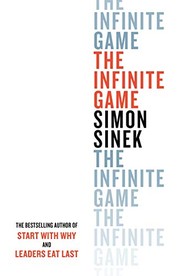
The Infinite Game
Why business is an infinite game with no end, and how to lead in one.
Summary
Sinek borrows James Carse's distinction between finite games, which have fixed rules, known players and an end point, and infinite games, which have changing players and no end. He argues that business is infinite, that most executives play it as if it were finite, and that this mismatch explains burnout, short-termism and the collapse of once-dominant firms.
He sets out five practices for infinite-minded leadership: advance a just cause that outlives any product, build trusting teams where people admit mistakes, study worthy rivals to reveal your own weaknesses, practise existential flexibility by making large strategic shifts to serve the cause, and show the courage to lead when the market punishes you for it. He attacks Milton Friedman's shareholder-primacy doctrine directly and endorses the stakeholder view.
The evidence is anecdotal. Sinek uses CVS dropping tobacco sales, Apple against Microsoft, Garmin against the iPhone, Victorinox after air-travel rules cut its knife sales, and the Vietnam-era army as recurring cases. There is no systematic data, no counterfactual, and no attempt to test whether infinite-minded firms actually outperform.
That is the main objection. The cases are chosen after the outcome is known, and several favourites have since performed poorly, which is the standard problem with business books built on selected examples. The framework still has practical use as a vocabulary for arguing against quarter-driven decisions inside a company.
Key takeaways 7
- Business has no finish line, so treating competitors as opponents to be beaten produces bad decisions.
- A just cause must be specific, inclusive, service-oriented, resilient and idealistic, not a restatement of financial targets.
- Shareholder primacy as Friedman defined it is a finite-game rule wrongly applied to an infinite game.
- Trusting teams form when leaders make it safe to admit error, not when they run engagement surveys.
- A worthy rival should be studied for what it reveals about your own weakness, not treated as a target to destroy.
- Existential flexibility means voluntarily abandoning a profitable business model to serve the cause.
- Leaders who cannot articulate a cause default to metrics, and metrics alone will not hold an organisation together.
Who should read it
Founders and executives who need language for defending long-horizon decisions to boards and teams, provided they treat the examples as illustration rather than proof.
About Simon Sinek
British-American author and speaker on leadership, organisational purpose and long-term competition.
Start with Why argues that organisations communicate, sell and recruit better when they lead with purpose ahead of product, and gives that argument a structure managers can apply to messaging and hiring. Leaders Eat Last and The Infinite Game extend it to how leaders create safety inside teams and how firms compete without a defined finish line.
Who recommended it 1
Similar books 6
Chosen by shared topics, the entries that hold them, and the people who recommended both.
Why leaders who state their purpose before their product earn loyalty.
Recommended by: Richard Branson, Tom Bilyeu, Tony Hsieh and 4 others
Why teams perform when leaders give up their own interest to keep people safe.
Recommended by: Alfred Lin, Julie Stevanja, Tom Bilyeu and 1 other
How leaders drive hypergrowth by raising standards, focus and urgency.
Recommended by: Jason Calacanis, Terrance McArthur
Profiles of business leaders from Investor's Business Daily's column.
Seven qualities, such as unconditional responsibility, of people who make firms work.
Recommended by: Sheryl Sandberg, Reid Hoffman
How Popeyes recovered when its chief chose to lead by serving others.
Recommended by: Mohnish Pabrai