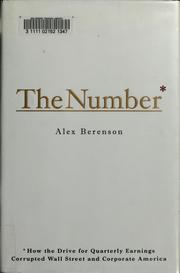
The Number
How quarterly earnings per share came to rule US companies, and what it led to.
How the earnings-per-share culture produced WorldCom-style accounting.
Summary
Alex Berenson covered Wall Street for the New York Times and wrote this history of how quarterly earnings per share came to dominate American corporate behaviour, and of what that dominance produced.
The historical section traces the development of American accounting and securities regulation from the nineteenth century through the establishment of the Securities and Exchange Commission, the professionalisation of auditing, and the emergence of the sell-side analyst. Berenson shows how a single number, earnings per share, came to be the focus of company disclosure, analyst forecasting and share price reaction, and how the growth of the analyst community created a consensus estimate that companies were then expected to meet exactly.
His argument is that meeting the number became the objective and that everything else followed from it: earnings management through reserve accounts and revenue recognition timing, the pressure on auditors whose consulting revenue depended on the client, the compensation of executives in options whose value depended on the share price, and eventually outright fraud at Enron, WorldCom and elsewhere. He documents the specific accounting techniques. The book was published in 2003, after Sarbanes-Oxley, and the auditor independence rules it argues for were partly adopted. Berenson is a reporter rather than an accountant and simplifies some technical material. The history of how one number came to dominate is the book's contribution.
Key takeaways 7
- Quarterly earnings per share became the single measure that companies, analysts and investors organised around.
- The analyst consensus estimate created a specific number companies were expected to meet, which made small misses disproportionately costly.
- Earnings management through reserves and revenue recognition timing was routine long before it became fraud.
- Auditors whose consulting revenue depended on the client could not enforce standards against that client.
- Option compensation gave executives a direct interest in the share price, which the earnings number drove.
- Berenson argues that fraud at Enron and WorldCom was the endpoint of a continuum rather than a departure from normal practice.
- Accounting numbers are estimates within ranges, and the pressure to hit a target determines where within the range a company reports.
Who should read it
Investors and directors who want the history of how quarterly earnings targets came to drive corporate behaviour and where that pressure leads.
Similar books 6
Chosen by shared topics, the entries that hold them, and the people who recommended both.
The accounting tricks British companies used to inflate profits, firm by firm.
A telecom analyst on the conflicts of interest in research during the 1990s bubble.
How companies dress up their reported operating cash flow, and how to spot it.
“Charles W. Mulford and Eugene E. Comiskey, Creative Cash Flow Reporting: Uncovering Sustainable Financial Performance (Hoboken, NJ: John Wiley & Sons, 2005)” — Michael Mauboussin
Source: Thirty Years: Reflections on the Ten Attributes of Great Investors, page 18
Recommended by: Michael Mauboussin, Mohnish Pabrai
The tricks companies use to inflate earnings, cash flow and key metrics, by case.
“Some of my favorites include Howard M. Schilit and Jeremy Perler, Financial Shenanigans: How to Detect Accounting Gimmicks & Fraud in Financial Reports, 3rd Edition (New York: McGraw Hill, 2010)” — Michael Mauboussin
Source: Thirty Years: Reflections on the Ten Attributes of Great Investors, page 18
Recommended by: Michael Mauboussin, Mohnish Pabrai and 1 other
How to spot weakening finances and coming earnings shortfalls in published accounts.
Recommended by: Mohnish Pabrai
How finance used complexity to hide risk from the 1980s through Enron.