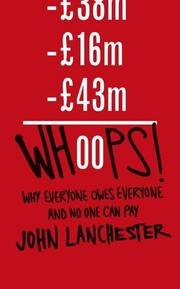
Whoops!
The financial crisis explained for readers with no background in finance.
Clearest lay explanation of the UK funding model
Summary
John Lanchester is a novelist who had been researching the financial world for fiction when the crisis arrived, and he wrote this explanation of it for readers with no financial background. It was published as I.O.U. in the United States.
His explanation covers the components in sequence: what a bank does and why banking is inherently fragile, the mortgage market and the securitisation that moved loans off originators' balance sheets, the credit default swap and how it converted credit risk into a traded instrument, the collateralised debt obligation and the tranching that produced triple-A rated securities from subprime loans, the ratings agencies and their business model, the risk models and their assumption of normally distributed returns, and the leverage that magnified the eventual losses.
His broader argument is cultural rather than technical: he holds that the crisis followed from a widely shared belief, held across the political spectrum after 1989, that markets had settled the argument about how societies should be organised, and that this belief removed the scepticism that would have questioned what the financial industry was doing. He is a good writer and the explanations are unusually clear, which is the book's principal value. It is not analysis and readers wanting the mechanism should go to Gorton or to the technical accounts. As a book to hand someone who wants to understand what happened, it remains among the best.
Key takeaways 7
- Banking is inherently fragile because banks fund long-dated illiquid assets with short-dated liabilities that can be withdrawn.
- Securitisation moved loans off originators' balance sheets, which removed their reason to care whether the loans were repaid.
- Tranching produced securities rated triple-A from pools of subprime loans, which depended entirely on correlation assumptions.
- Ratings agencies were paid by the issuers whose securities they rated, which is the conflict at the centre of the structure.
- Risk models assumed normally distributed returns, which understates the probability of the events that actually occurred.
- Lanchester argues that a shared belief in markets after 1989 removed the scepticism that would have questioned the industry.
- The book explains the mechanism clearly for a general reader and does not analyse it.
Who should read it
Readers who want the 2008 crisis explained clearly from first principles by a writer with no professional stake in it.
Similar books 6
Chosen by shared topics, the entries that hold them, and the people who recommended both.
Northern Rock's failure, the first British bank run in a century, and the crisis.
Northern Rock's failure from several angles: business model, funding and regulation.

Northern Rock's rise from building society to mortgage lender, and its collapse.
The 2008 crisis traced back 25 years to mortgage bonds, Fannie Mae and subprime.
“Bethany McLean and Joe Nocera, All the Devils Are Here: The Hidden History of the Financial Crisis (New York: Portfolio, 2010), 128-134” — Michael Mauboussin
Source: Blaming the Rat: Incentives, Motivation, and How They Interact, page 14
Recommended by: Michael Mauboussin
How subprime lenders and Wall Street built the mortgage bubble and the crisis.
How a JPMorgan team invented credit default swaps that other banks then misused.