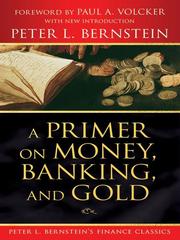
A Primer on Money, Banking, and Gold
Open Library unreachable during build; every openlibrary.org query failed with connection errors
Summary
Bernstein wrote this in 1965 as an explanation of the monetary system for general readers, and it was reissued in 2008 with a new foreword by Paul Volcker and additional commentary.
The explanatory content is the strength. Bernstein explains what money is and why anything functions as it, how commercial banks create deposits through lending and how the reserve system constrains this, how the Federal Reserve's open market operations affect bank reserves and therefore the money supply, what determines the demand for money, and how the whole connects to output, employment and prices. He explains the balance sheet mechanics rather than describing them, so the reader can follow what happens to each account when a transaction occurs.
The gold sections cover the international system as it then stood: the Bretton Woods arrangement of dollar convertibility into gold at a fixed price, the balance of payments constraint this imposed on the United States, and the growing problem that foreign dollar holdings exceeded American gold reserves. Bernstein sets out the argument, later associated with Robert Triffin, that the system contained a contradiction, since the world needed dollar liquidity that could only be supplied by American deficits, which would eventually undermine confidence in convertibility.
The 2008 edition's value is that it explains the monetary mechanics clearly at a time when many readers were trying to understand central bank operations for the first time.
The institutional detail is badly dated. The gold link ended in 1971, reserve requirements have since been eliminated in the United States, the money multiplier framework Bernstein presents has been superseded by an account in which lending drives deposits and reserves follow, and central banks now operate with interest on reserves rather than through reserve scarcity. Read it for the conceptual explanation and check the operational detail against current sources.
Key takeaways 7
- Commercial banks create deposits through lending, so most of what functions as money is created by private institutions rather than by the state.
- Open market operations change bank reserves, which under the framework of the period determined the quantity of deposits banks could support.
- Money's acceptability rests on the expectation that others will accept it, which is why confidence rather than backing sustains it.
- Under Bretton Woods the world needed dollar liquidity that only American deficits could supply, which eventually undermined confidence in convertibility.
- A fixed exchange rate commitment requires the issuing country to subordinate domestic policy to defending it.
- The relationship between money, output and prices runs through spending decisions rather than mechanically.
- The operational framework described here has been superseded, since reserve requirements were eliminated and central banks now use interest on reserves.
Who should read it
Readers who want the conceptual mechanics of money and banking explained clearly, checking operational details against current central bank practice.
About Peter L. Bernstein
Founder, Peter L. Bernstein Inc.; founding editor of The Journal of Portfolio Management; economist and financial historian (1919-2009)
Against the Gods and Capital Ideas are the standard accounts of risk and of modern finance theory, read across the whole field.
Where it sits in the reference 2
Similar books 6
Chosen by shared topics, the entries that hold them, and the people who recommended both.