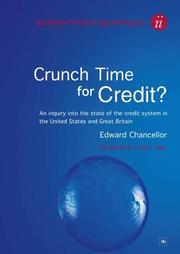
Crunch-Time for Credit? An Inquiry into the State of the Credit System in the United States and Britain
Listed on his own site; Open Library unreachable during build
Summary
Chancellor, the financial historian who wrote Devil Take the Hindmost, produced this study in 2005 examining the state of credit in the United States and Britain.
The reference has not verified the report's detailed contents. Its significance is its timing and its author. Chancellor had written the standard history of financial speculation and had worked as an analyst, and this study examined the credit expansion then under way, two years before it broke.
The conditions Chancellor was examining included household debt at record levels relative to income in both countries; house prices at record multiples of earnings; mortgage lending standards deteriorating, with the growth of interest-only, self-certified and high loan-to-value lending; the growth of securitisation, which moved credit risk off bank balance sheets and severed the connection between the party assessing the borrower and the party bearing the loss; the expansion of credit derivatives; low measured volatility and compressed credit spreads, which Chancellor's own historical work identified as characteristic of late-cycle conditions; and the belief that risk had been distributed to those best able to bear it, which was the official view at the time.
Chancellor's general analytical position, developed in his other work and applied since as a strategist and columnist, is that credit expansion drives asset cycles, that suppressed interest rates encourage borrowing and misallocate capital, and that periods of apparent stability generate the risk-taking that ends them.
The study is a policy pamphlet rather than a book and readers should verify its specific arguments. Its interest is as documentation that the conditions were identified and published before the crisis.
Key takeaways 7
- Household debt relative to income reached record levels in the United States and Britain before the crisis.
- Mortgage lending standards deteriorated through interest-only, self-certified and high loan-to-value products.
- Securitisation severed the connection between the party assessing a borrower and the party bearing the eventual loss.
- Compressed credit spreads and low measured volatility are characteristic of late-cycle conditions rather than of genuine safety.
- The official view that risk had been distributed to those best able to bear it was untested and turned out to be wrong.
- The conditions that produced the crisis were identified and published in 2005 by observers using historical analysis.
- Credit expansion drives asset cycles, and periods of apparent stability generate the risk-taking that ends them.
Who should read it
Readers interested in what was identifiable before the crisis and in credit cycle analysis applied contemporaneously.
About Edward Chancellor
Financial historian and investment strategist; formerly Lazard Brothers, GMO and Breakingviews; columnist, Reuters Breakingviews
Devil Take the Hindmost remains the standard history of speculative bubbles, and The Price of Time did the same job for interest rates.
Where it sits in the reference 2
Similar books 6
Chosen by shared topics, the entries that hold them, and the people who recommended both.