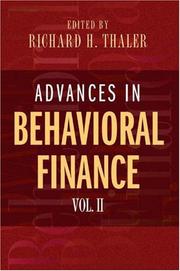
Advances in Behavioral Finance, Volume II
Edited volume.
Summary
Thaler edited this second collection twelve years after the first, covering the work behavioural finance produced during the intervening period. The papers are more theoretically developed than those in the original volume.
The collection includes the models built to explain the anomalies rather than only the documentation of them. Barberis, Shleifer and Vishny's model of investor sentiment derives both underreaction at short horizons and overreaction at long ones from a single account of how investors update beliefs. Daniel, Hirshleifer and Subrahmanyam's model derives similar patterns from overconfidence and biased self-attribution. Hong and Stein's model derives them from the interaction between traders who use fundamental information and those who follow price trends.
Other papers cover the limits of arbitrage more formally, including Shleifer and Vishny's argument that arbitrage capital contracts exactly when opportunities are widest; the equity premium and its explanation through myopic loss aversion, where investors evaluating portfolios frequently experience the pain of losses more often; the disposition effect, meaning the tendency to sell winners and hold losers, documented in individual investor account data; corporate finance applications including market timing in equity issuance and the effect of investor sentiment on managerial decisions; and evidence from the technology bubble including the Palm and 3Com case where a subsidiary's market value exceeded that of its parent.
Thaler's introduction assesses what the field had established and what remained contested.
The papers are technical. Behavioural asset pricing remains contested: the models are criticised for having enough free parameters to fit any pattern, and defenders of efficiency argue the anomalies reflect risk factors that are not observed. Several documented effects have weakened in subsequent data.
Key takeaways 7
- Models based on how investors update beliefs can generate both short-horizon underreaction and long-horizon overreaction from a single mechanism.
- Arbitrage capital contracts exactly when mispricings are widest, because investors withdraw from managers whose positions have moved against them.
- Investors who evaluate their portfolios frequently experience losses more often, which under loss aversion explains the size of the equity premium.
- Individual investors sell winning positions and hold losing ones, which is documented directly in account data.
- Companies issue equity when their shares are expensively valued, which indicates managers act on mispricing rather than ignoring it.
- The Palm and 3Com episode produced a subsidiary market value exceeding that of the parent that owned it, which no arbitrage corrected.
- Behavioural asset pricing models are criticised for having enough parameters to fit any observed pattern after the fact.
Who should read it
Researchers and quantitative investors who want the theoretical development of behavioural finance and the evidence on limits to arbitrage.
About Richard H. Thaler
Charles R. Walgreen Distinguished Service Professor of Behavioral Science and Economics, University of Chicago Booth School of Business; co-founder, Fuller & Thaler Asset Management; Nobel laureate in economics 2017
The Anomalies series and Nudge are the primary sources for behavioral economics as an applied discipline in finance and public policy.
Where it sits in the reference 2
Similar books 6
Chosen by shared topics, the entries that hold them, and the people who recommended both.