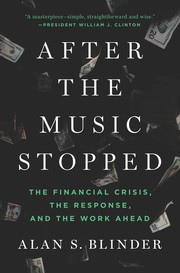
After the Music Stopped
The clearest economist's account of the crisis and the policy response.
Summary
Blinder, a Princeton economist and former Federal Reserve vice chairman, wrote an explanation of the financial crisis, the policy response and the aftermath, aimed at general readers but written by someone who understands the technical material.
The causal account identifies multiple contributing factors rather than a single cause: the housing bubble; the deterioration of mortgage underwriting; the securitisation chain that separated the originator from the ultimate holder and removed the incentive to assess credit; the rating agencies' failure and the conflict created by issuer payment; excessive leverage across the financial system, particularly at investment banks and in off-balance-sheet vehicles; the growth of credit derivatives without central clearing or collateral discipline; regulatory gaps including the exemption of derivatives and the absence of any regulator with a systemic mandate; and compensation structures rewarding volume and short-term results.
The policy chapters explain what was done and defend most of it. Blinder walks through the Federal Reserve facilities, the Troubled Asset Relief Program, the stress tests which he regards as the single most effective intervention, the automobile rescues, and the fiscal stimulus. He argues that the response prevented a depression, that it was less costly than the public believes since most of the capital was repaid, and that it was politically catastrophic because it appeared to rescue the people responsible.
The reform chapters assess the Dodd-Frank Act, identifying what it addressed and what it did not.
Blinder is a participant in the policy world defending broadly the actions taken, and readers should weigh that. His treatment of alternatives, particularly on mortgage principal reduction where he is critical of what was done, is more nuanced than his defence of the bank rescues. The book is one of the clearest single-volume explanations of the technical mechanisms for a non-specialist reader.
Key takeaways 7
- Securitisation separated the mortgage originator from the ultimate holder, which removed the incentive to assess whether the borrower could pay.
- Rating agencies were paid by issuers and rated instruments whose models they had helped design, which is a structural conflict rather than negligence.
- Leverage at investment banks and in off-balance-sheet vehicles meant small asset value declines eliminated equity entirely.
- No regulator had a mandate covering the financial system as a whole, so risks that crossed institutional boundaries were nobody's responsibility.
- The 2009 bank stress tests were the most effective single intervention because they resolved uncertainty about which institutions were solvent.
- Most of the capital deployed in the rescue programmes was repaid, so the fiscal cost was far smaller than the public believes.
- The rescue succeeded economically and failed politically, because it appeared to protect the people who caused the crisis.
Who should read it
Readers who want one clear explanation of the crisis mechanisms and the policy response from someone who understands both.
Where it sits in the reference 2
Similar books 6
Chosen by shared topics, the entries that hold them, and the people who recommended both.