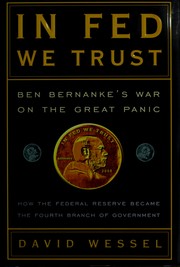
In Fed We Trust
The Fed side of the Bear rescue and its precedent; Open Library unreachable.
Summary
Wessel, the Wall Street Journal's economics editor, covers the Federal Reserve's response to the 2008 crisis, centred on Ben Bernanke and on the decisions made between August 2007 and the spring of 2009. He had access to the principals and reconstructs the internal deliberations.
The substance is what the Fed did and why, in sequence: the discount window changes, the Term Auction Facility, the Bear Stearns rescue through JPMorgan, the decision not to rescue Lehman, the AIG loan two days later, the commercial paper and money market facilities, the swap lines with foreign central banks, and quantitative easing. Wessel is careful about the legal constraints, particularly the requirement that emergency lending be secured to the Fed's satisfaction, and about the internal disagreement over Lehman.
His account of the Lehman decision is the most contested part. Wessel reports the official position, that the Fed lacked a legal basis because Lehman had insufficient collateral, and also the evidence that political considerations after Bear Stearns influenced the outcome, and he does not fully resolve the two.
The book is a first draft written in 2009 and it accepts the participants' framing more than later accounts do. It is valuable for the institutional detail, for showing how much of the response was improvised under legal authorities designed for other purposes, and for Bernanke's own intellectual formation as a Depression scholar, which Wessel argues determined the aggressiveness of the response.
Key takeaways 7
- Bernanke's academic work on the Depression determined his response, since he had concluded that the central error in the 1930s was insufficient and delayed action.
- The Federal Reserve's emergency authorities were designed for other purposes and were reinterpreted under time pressure to permit each intervention.
- The Bear Stearns rescue created an expectation of support that made the subsequent Lehman decision more damaging than it would otherwise have been.
- The official reason for not rescuing Lehman was insufficient collateral to secure a loan, and political constraints after Bear Stearns were also present in the decision.
- Central bank swap lines with foreign institutions were among the largest and least noticed interventions, because dollar funding shortages abroad threatened American markets directly.
- The Fed acted as lender of last resort to institutions it did not regulate, which exposed the gap between its supervisory authority and its financial responsibility.
- Quantitative easing was adopted after conventional policy reached zero, and its adoption was a departure the institution had no framework for evaluating.
Who should read it
Investors and policy readers who want the institutional account of what the Federal Reserve did in 2008 and under what legal authority.
Where it sits in the reference 3
Who recommended it 1 · 1 direct
Similar books 6
Chosen by shared topics, the entries that hold them, and the people who recommended both.