Alexander Hamilton
Chernow on the man who built American public credit and its bank
Summary
Chernow's biography covers Hamilton from his illegitimate birth in the West Indies through his arrival in New York, his service as Washington's aide, his role in the Constitutional Convention and the Federalist Papers, his tenure as the first Treasury Secretary, and his death in the 1804 duel with Aaron Burr. It is the source for the Miranda musical.
The financial material is the reason to read it for a business audience. Hamilton designed the American financial system essentially from nothing. He assumed the states' Revolutionary War debts into federal obligations, which converted creditors into supporters of the national government; he insisted on paying the debt at full face value to establish credit, including to speculators who had bought at discounts from the original holders; he created the Bank of the United States over Jefferson's constitutional objections; he established a national currency and the mint; and he used tariffs and an excise to service the debt.
Chernow's argument is that Hamilton understood that a properly structured national debt would function as a national asset by creating a liquid market in government securities and by binding capital to the state's survival, which was a genuinely novel position in America at the time.
The book is long and sympathetic to Hamilton throughout, treating Jefferson unfavourably in ways historians have disputed. The financial policy is explained clearly but with limited attention to the distributional consequences, particularly for the original debt holders who sold at discounts. It remains the best available account of how a financial system was designed from first principles by one person.
Key takeaways 8
- Hamilton designed the American financial system from nothing, including the debt structure, the bank, the currency and the revenue mechanisms.
- Assuming state debts into federal obligations converted creditors into supporters of the national government, which was a political purpose as much as a financial one.
- Paying the war debt at full face value established the credit of a new country, and Hamilton insisted on it despite the windfall it gave to speculators.
- A properly structured national debt functions as a national asset by creating a liquid securities market and binding capital holders to the state's survival.
- A national bank was necessary to provide credit and a uniform currency, and Hamilton defended it through implied constitutional powers over Jefferson's objection.
- Establishing credit early is what allowed the United States to borrow cheaply for the following century.
- Hamilton's arguments for manufacturing and for federal support of industry lost politically in his lifetime and shaped policy afterwards.
- Chernow is sympathetic to Hamilton and unfavourable to Jefferson in ways historians have disputed.
Who should read it
Readers interested in how a financial system and a sovereign credit position were designed from first principles, in a long and admiring biography.
About Ron Chernow
American biographer and financial historian who writes archival lives of Rockefeller, the Morgans, the Warburgs and Alexander Hamilton.
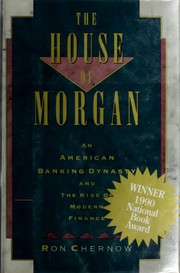
Titan and The House of Morgan reconstruct from company and family archives how Standard Oil consolidated an industry and how a private bank organised American capital before securities regulation existed. Both carry the detail on trust structures, rebates, syndicates and succession that later histories of American business cite.
Where it sits in the reference 3
Who recommended it 4 · 2 direct
Similar books 6
Chosen by shared topics, the entries that hold them, and the people who recommended both.