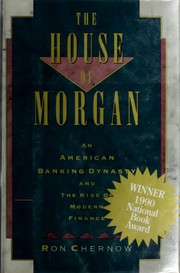
The House of Morgan: An American Banking Dynasty and the Rise of Modern Finance
On the predecessor houses; National Book Award winner.
Summary
Chernow traces the Morgan banking houses from George Peabody's London firm in the 1830s through J. S. Morgan, J. Pierpont Morgan, the 1933 separation into J.P. Morgan and Morgan Stanley under Glass-Steagall, and the transformation into modern investment banking through the 1980s. It won the National Book Award.
He organises the history into three eras. The Baronial Age covers the period when the bank exercised power that governments did not, including Pierpont Morgan's organisation of the 1907 panic rescue from his library, the assembly of United States Steel, and the reorganisation of the railroads. The Diplomatic Age covers the interwar period, when the firm acted as an instrument of American foreign policy in the reparations negotiations and in loans to European governments. The Casino Age covers the postwar period, when relationship banking gave way to transactional competition and the firm's client relationships stopped being exclusive.
The analytical thread is the decline of relationship banking. Morgan's power rested on exclusive long-term client relationships in which a company used one bank for everything, and on the reputation that made a Morgan endorsement sufficient. The transition to competitive bidding and to transactional deal-making destroyed both.
The book is over eight hundred pages and covers a century and a half, so no episode receives exhaustive treatment. Chernow writes narrative history rather than financial analysis. It is the standard account of how the relationship between finance, government and industry changed across the period in which modern banking was created.
Key takeaways 8
- Morgan's power rested on exclusive long-term client relationships in which a company used a single bank for all its financing.
- A Morgan endorsement functioned as a substitute for disclosure and regulation, since investors bought on the bank's reputation rather than on information.
- Pierpont Morgan organised the 1907 panic rescue personally because no institution existed to perform the function, which led directly to the creation of the Federal Reserve.
- The bank reorganised the American railroads and assembled United States Steel, exercising industrial control that came from financing rather than from ownership.
- Glass-Steagall separated commercial from investment banking in 1933 and split the firm, which shaped the structure of American finance for six decades.
- During the interwar period the bank operated as an instrument of American foreign policy in reparations and sovereign lending.
- The shift from relationship banking to competitive bidding destroyed the exclusivity that the business model depended on.
- Regulation, disclosure requirements and the growth of competing firms progressively removed the informational advantage that made the bank's position possible.
Who should read it
Readers interested in how finance, industry and government were connected before regulation and disclosure, and how relationship banking ended.
About Ron Chernow
American biographer and financial historian who writes archival lives of Rockefeller, the Morgans, the Warburgs and Alexander Hamilton.
Titan and The House of Morgan reconstruct from company and family archives how Standard Oil consolidated an industry and how a private bank organised American capital before securities regulation existed. Both carry the detail on trust structures, rebates, syndicates and succession that later histories of American business cite.
Where it sits in the reference 6
Who recommended it 2 · 1 direct
Similar books 6
Chosen by shared topics, the entries that hold them, and the people who recommended both.