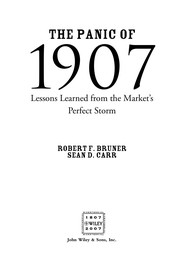
The Panic of 1907
Morgan acting as lender of last resort before there was a Fed.
Summary
Bruner and Carr reconstruct the October 1907 panic day by day, beginning with the failed corner in United Copper, moving through the run on the Knickerbocker Trust Company, and ending with the syndicate J.P. Morgan assembled in his library to stop the contagion. They draw on newspaper accounts, clearinghouse records, Congressional testimony and the correspondence of the principals.
The analytical spine is a checklist of conditions the authors argue precede most financial crises: system complexity, buoyant growth, inadequate safety buffers, adverse leadership, a real economic shock, undue fear and greed, and a failure of collective action. They apply this frame to 1907 and argue the panic was not caused by any single villain but by a system that had grown faster than its shock absorbers, with trust companies operating outside the clearinghouse reserve discipline that protected national banks.
The book is short and readable, and it is the standard popular account of the episode that produced the Federal Reserve Act six years later. Its main use for investors is as a case study in how liquidity crises propagate through institutions that appear healthy on paper, and how private coordination substitutes badly for a lender of last resort. The seven-factor framework is loose enough to fit almost any crisis after the fact, and historians of the period have pushed back on the heroic treatment of Morgan, who profited from several of the rescues he arranged. Readers wanting the monetary-history argument in depth should pair it with Friedman and Schwartz or with Gorton on the trust-company run mechanism.
Key takeaways 7
- The 1907 panic began in the trust companies, which faced bank-like runs while holding far lower cash reserves than national banks and standing outside clearinghouse mutual support.
- Financial crises follow a recurring pattern in which a growing, complex system with thin buffers meets a real shock and then fails at collective action.
- J.P. Morgan's private syndicate performed the functions a central bank would later perform, and did so only because one man could compel cooperation among rivals.
- The San Francisco earthquake of 1906 drained gold and capital from New York and left the system with less slack than it appeared to have.
- Public confidence, not solvency, determined which institutions survived the panic.
- The episode directly produced the Aldrich-Vreeland Act and the National Monetary Commission, and through them the Federal Reserve.
- Crisis intervention worked when it was fast, large and visibly credible, and failed when rescuers hesitated over whether a firm deserved saving.
Who should read it
Investors and operators who want a compact case study of how a liquidity crisis moves through institutions and why lender-of-last-resort capacity exists.
Where it sits in the reference 3
Who recommended it 2 · 2 direct
Similar books 6
Chosen by shared topics, the entries that hold them, and the people who recommended both.