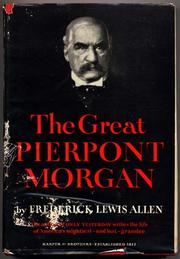
The Great Pierpont Morgan
The short classic account, written while the memory was still live.
Summary
Allen, a popular historian, wrote a short biography of J. Pierpont Morgan covering his career from the Civil War through his death in 1913, including the railroad reorganisations, the formation of United States Steel, the 1895 gold loan to the Treasury, the 1907 panic, and the Pujo Committee hearings.
The business content concerns what Morgan actually did. Allen explains Morganisation, the reorganisation of bankrupt or over-built railroads into financially viable systems by writing down capital, consolidating competing lines, imposing conservative financial policy and placing Morgan representatives on boards. He shows this was the source of Morgan's power: the firm controlled the access of American enterprises to European capital, and the discipline it imposed as a condition of that access gave it authority over an enormous share of American industry without owning it.
Allen covers the 1895 transaction in which Morgan's syndicate supplied gold to the United States Treasury when its reserve was nearly exhausted, and the 1907 panic in which he coordinated the private rescue. Both demonstrated that no public institution existed to perform these functions, which is what produced the Federal Reserve.
The book is from 1949 and is popular rather than scholarly, written before the archival work that later biographies drew on. Ron Chernow's The House of Morgan is the fuller modern treatment. Allen's account is short, readable and reasonably balanced about Morgan's power, and it conveys the mechanism of Morganisation more clearly than longer works do.
Key takeaways 7
- Morganisation meant reorganising over-built railroads by writing down capital, consolidating competing lines and imposing conservative financial policy as a condition of refinancing.
- Morgan's power came from controlling American access to European capital rather than from owning the companies he directed.
- Placing representatives on the boards of reorganised companies gave the firm continuing control without ownership, which is how the influence extended across industries.
- Consolidation was undertaken to end destructive competition that had bankrupted the railroads, and the resulting monopoly power was a consequence rather than the object.
- The 1895 gold loan and the 1907 rescue both demonstrated that a private banker was performing functions no public institution existed to perform.
- Morgan believed competition in capital-intensive industries was destructive and that combination produced stability, which was a coherent position rather than only self-interest.
- The concentration of financial power the Pujo Committee documented produced the political conditions for the Federal Reserve and for later banking legislation.
Who should read it
Readers who want a short accessible account of how Morgan's control worked, with Chernow's House of Morgan as the fuller treatment.
About Frederick Lewis Allen
American editor of Harper's Magazine who wrote popular histories of the 1920s boom, the crash and J. P. Morgan.
Only Yesterday appeared within two years of the 1929 crash and records the Florida land boom, the margin mania and the mood of the decade as contemporaries experienced them, before hindsight tidied the story. The Big Change and The Great Pierpont Morgan carry that reporting into how American wealth and finance reorganised across the first half of the century.
Where it sits in the reference 4
Similar books 6
Chosen by shared topics, the entries that hold them, and the people who recommended both.