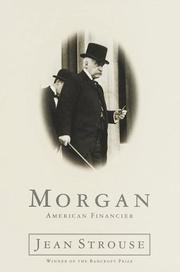
Morgan: American Financier
The definitive Pierpont Morgan biography, complementing Chernow's house history.
Summary
Strouse spent years on this biography of J Pierpont Morgan, working from family papers, business records and correspondence that earlier biographers had not used. She wrote it to replace both the hostile portrait of Morgan as a predatory monopolist and the reverential one produced by his authorised biographer.
The financial argument concerns what Morgan actually did. Strouse presents him as an intermediary between European capital, principally British, and American industrial development, whose function was to make American securities safe enough for foreign investors to buy. This required imposing order on the industries he financed. His reorganisations of bankrupt railroads, which contemporaries called Morganisation, reduced debt, eliminated competitive rate wars through community of interest arrangements, and placed his partners on boards to monitor the companies afterward. Strouse argues that Morgan's hostility to competition was not simple monopolism but a belief that destructive competition in capital-intensive industries destroyed the capital he had placed with investors, and that stability served the investors he represented.
The major episodes are covered fully: the 1895 gold syndicate that supplied the Treasury with gold and defended the dollar's convertibility, the creation of United States Steel in 1901 as the first billion-dollar corporation, the Northern Pacific corner, the 1907 panic during which Morgan personally organised the rescue that no central bank existed to perform, and the 1912 Pujo Committee hearings on the money trust shortly before his death.
Strouse also covers the private life, the art collecting on an enormous scale, and the physical and psychological details.
The book is long and the personal material takes considerable space. Strouse is sympathetic to Morgan and readers should note that her interpretation of his motives is contested by historians who emphasise the anti-competitive effects regardless of intent. The 1907 chapters are the best account of that episode in any biography.
Key takeaways 7
- Morgan's central function was making American securities acceptable to European investors, which required imposing financial discipline on the companies he financed.
- Railroad reorganisation under Morgan reduced debt and suppressed rate competition, and his partners then sat on the boards to enforce it.
- His hostility to competition rested on the argument that rate wars in capital-intensive industries destroyed investors' capital.
- In 1907 a private banker organised the rescue of the financial system because no institution existed to do it, which is the strongest argument for a central bank.
- United States Steel was assembled in 1901 as the first billion-dollar corporation by buying out Carnegie and combining competitors.
- The 1895 gold syndicate demonstrated that private bankers could defend a national currency, and that the government had no alternative.
- Morgan's power came from the trust of investors who bought what he underwrote, so his reputation was the actual asset.
Who should read it
Investors and financiers who want the fullest account of how one intermediary imposed capital discipline on American industry, and what happened when no central bank existed.
Where it sits in the reference 3
Similar books 6
Chosen by shared topics, the entries that hold them, and the people who recommended both.