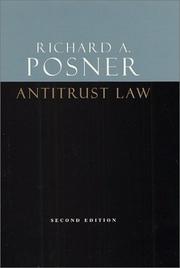
Antitrust Law
The Chicago School's economic reformulation of doctrine.
Summary
Posner wrote this as an economic analysis of antitrust law, arguing that the field should be governed entirely by economic reasoning about efficiency rather than by legal categories or by concern for competitors.
His positions align closely with Bork's, though Posner's treatment is more technical and he differs on specifics. He argues that the only proper goal of antitrust is economic efficiency, that most vertical arrangements including resale price maintenance and exclusive dealing do not reduce output and should be permitted, that predatory pricing is rarely a rational strategy because the losses during the campaign exceed what can be recovered, that the law should focus on cartel behaviour and on horizontal mergers producing substantial concentration, and that the courts' historical hostility to size and to efficient competitors harmed consumers.
His distinctive contributions include the analysis of tacit collusion, meaning coordination among firms without explicit agreement. Posner argues that in concentrated markets firms can reach supracompetitive prices through interdependent behaviour without communicating, that this produces the same harm as an explicit cartel, and that antitrust should therefore be able to reach it. This position was more interventionist than the rest of his framework and has been influential without being adopted by courts, which have generally required evidence of agreement.
The second edition, published in 2001, revised the treatment substantially in light of the intervening development of the law and of industrial organisation economics, including the game-theoretic literature that complicated several of the original conclusions.
Posner's framework, like Bork's, dominated American antitrust for decades and is now under sustained challenge from scholars arguing that price-focused analysis fails in platform markets, that concentration has risen with measurable harms, and that the efficiency-only goal was never what the statutes intended. Posner himself later expressed doubts about aspects of the consumer welfare approach as applied.
Key takeaways 7
- Antitrust law should be governed by economic analysis of efficiency rather than by legal categories or by protection of competitors.
- Most vertical arrangements do not reduce output and should therefore be permitted regardless of their effect on individual distributors.
- Predatory pricing is rarely rational because the losses during the campaign exceed what can be recovered afterward.
- Firms in concentrated markets can reach supracompetitive prices through interdependent behaviour without any explicit agreement.
- Tacit collusion produces the same harm as an explicit cartel and should be reachable by antitrust law even without evidence of agreement.
- Courts historically penalised efficient firms for their size, which harmed the consumers antitrust exists to protect.
- Cartel conduct and horizontal mergers producing substantial concentration are where enforcement effort should be concentrated.
Who should read it
Lawyers, economists and operators who want the rigorous economic statement of the framework that governed American antitrust for four decades.
Where it sits in the reference 2
Similar books 6
Chosen by shared topics, the entries that hold them, and the people who recommended both.