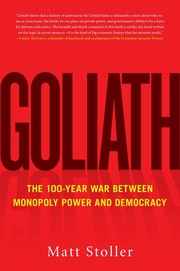
Goliath
A century of American anti-monopoly politics.
Summary
Stoller, an anti-monopoly researcher, writes a political history of American concentration and the anti-monopoly tradition, arguing that opposition to concentrated economic power was a central strand of American politics for most of the country's history and was deliberately abandoned in the 1970s.
His narrative centres on Wright Patman, the Texas congressman who spent decades attacking chain stores, bank concentration and the Federal Reserve, and whom Stoller treats as the representative figure of the tradition. He covers the Populist movement, the Brandeis position that concentration is a political rather than economic problem, the New Deal's anti-monopoly programme, the postwar antitrust enforcement that constrained large firms, and then the shift. He argues the change came from within the Democratic party in the 1970s, from a new generation that regarded anti-monopoly as outdated and regulation as inefficient, combined with the Chicago school's intellectual work and Robert Bork's consumer welfare standard.
His current application argues that concentration in technology, agriculture, pharmaceuticals, healthcare, banking and defence has produced political power, reduced dynamism, suppressed wages and hollowed out regional economies.
The book is polemical and history in service of an argument. Historians have criticised the treatment of Patman as heroic, the compression of the 1970s shift into a single ideological decision, and the selection of evidence. The core historical claim, that American politics contained a sustained anti-monopoly tradition that was abandoned rather than refuted, is well supported and is the book's contribution.
Key takeaways 7
- Opposition to concentrated economic power was a sustained strand of American politics for most of the country's history and was abandoned rather than refuted.
- The anti-monopoly tradition treated concentration as a political problem about who holds power rather than as an economic problem about prices.
- The shift to a consumer welfare standard came from within the Democratic party in the 1970s as much as from the Chicago school.
- Postwar antitrust enforcement constrained large firms in ways that created space for new entrants, and its abandonment closed that space.
- Concentration in technology, agriculture, healthcare and defence produces political power that no price-based analysis detects.
- Regional economies hollow out when local firms are acquired by national ones, because the decisions, the professional employment and the civic capacity leave with the headquarters.
- Chain store and bank concentration were live political questions for decades, which shows the current debate is a resumption rather than a novelty.
Who should read it
Investors and operators in concentrated industries who want the political history behind the current anti-monopoly argument.
Where it sits in the reference 2
Who recommended it 1
Similar books 6
Chosen by shared topics, the entries that hold them, and the people who recommended both.